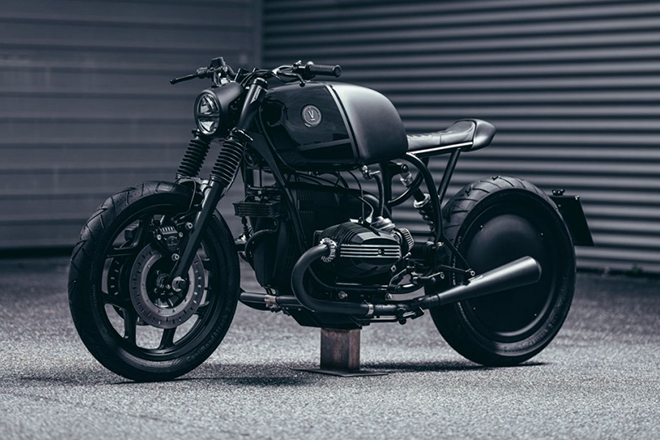
Vagabund Moto’s Menacing, Post-Apocalyptic Beauty: The 1994 V12 BMW R100RT

100% street legal and ready for use, the 1994 V12 BMW R100RT by Vagabund Moto is the epitome of meticulous perfection, performance and style.
Dec 17, 2019 | By Prince Chahal
Straight out of Austria, Vagabund Moto’s custom built motorcycles by Paul Brauchart and Philip Rabl have a reputation for detail-oriented perfection, performance and style. Further unleashing their creative potential, the duo’s latest creation, the 1994 V12 BMW R100RT confirms all that we know and love about the brand.

Vagabund Moto’s Menacing, Post-Apocalyptic Beauty: The 1994 V12 BMW R100RT

Its build centers around a new and improved custom tank creating a considerable amount of heft, giving the bike a bulkier appearance, and an additional modified black ceramic exhaust system coated with HATTECH Y-pipe and a silencer.
Looking like a stealthy and futuristic high performance bike from a post-apocalyptic cyberpunk movie, the V12 BMW R100RT features Continental RoadAttack tyres and a custom leather seat with integrated lights attached to a 3D printed rear end.
Other 3D printed elements include the headlight housing which along with the V12’s handlebar controls and fork covers, feature LED turn signals.
With the rear wheel adorned in a blacked out glass fiber reinforced plastic cover and a shortened LSL street bar modified unto its frame, the V12 BMW R100RT’s front fork which has been reduced by 60mm – presents a forward-leaning and ferocious ready-to-charge attitude.
Coupled with an overall menacing persona, the V12 BMW R100RT’s design is not only immensely striking, it’s 100% street legal and ready for use.

Pearl 62 Designed by Dixon and Hoppen To Premiere at Boot Dusseldorf 2020

New Pearl 62 by British brand Pearl Yachts features Bill Dixon exterior and Kelly Hoppen interior, and joins existing 65, 80 and 95 models.
Dec 19, 2019 | By Yacht Style
Pearl Yachts will stage the world premiere of the Pearl 62 at the 51st edition of Boot Dusseldorf (January 18-26, 2020), with the newcomer joining the current 65, 80 and 95 models.
The Pearl 62 will feature a specially designed sunbed foredeck

With an exterior by Bill Dixon, the Pearl 62 will feature a triple sunbed forward
The new model succeeds the Pearl 60, the British brand’s most popular model to date. Equipped with a choice of twin Volvo IPS engines, the Pearl 62 is expected to have a top speed of up to 33 knots and a cruising range of 300 miles.
The new model was developed by Pearl’s usual team of renowned yacht designer Bill Dixon for exterior, and celebrity interior designer Kelly Hoppen MBE, who has worked with the likes of David and Victoria Beckham.
Measuring 18.6m (61ft) in length with a beam of 5.3m (17ft 4in), the Pearl 62 features an aft-galley layout and four guest cabins including a full-beam master suite with private entrance. Arguably the yacht’s signature feature is its large flybridge, which features three separate seating zones, a fully-equipped bar and a barbecue area.
The Pearl 62 is designed for an active lifestyle on the sea, but also has four cabins

The Pearl 62 is designed for an active lifestyle on the sea, but also has four cabins
Dixon said: “The stunning flybridge layout occupies the whole length and I believe we have succeeded in creating a class-leading design. The emphasis is on offering the owner a great lifestyle from the forward seating and sunbathing area to the aft deck and hi-lo platform, with great connection to the sea and dedicated storage for toys.”
Hoppen has created what she describes as a “chic, cutting-edge yacht interior”, centred around sleek detailing, from ribbed walls to luxurious suede bands on the cushions.
“Every nuance was considered for Pearl 62, from bespoke, forward-thinking storage solutions and gadgets to high-end detailing,” Hoppen said.
Kelly Hoppen continued her work for Pearl on the 62, designing a “chic, cutting-edge yacht interior”

Kelly Hoppen continued her work for Pearl, designing a “chic, cutting-edge yacht interior”
“This interior allows the owner to add their personal touches, which gives her a unique appeal. The luxurious appeal of a traditional superyacht was retained by using exquisite joinery and detailing along with my signature neutrals, ensuring every detail blended seamlessly.”
All newly launched Pearl yachts are covered by a comprehensive five-year warranty programme.
The original article appears in Yacht Style Issue 50. Email subscribe@lux-inc.com for print subscription enquiries or subscribe to the Magzter version at: www.magzter.com/SG/Lux-Inc-Media/Yacht-Style/Fashion/

Snapchat x Gucci Debut Limited Edition AR Spectacles at Miami Beach Art Basel

Snapchat’s Spectacles 3 capture three-dimensional photos and videos which can be edited with AR filters and effects through mobile devices.
Dec 11, 2019 | By Julia Roxan
The Spectacles 3 are the latest Snapchat Inc’s camera-equipped glasses, a concept first introduced as $130 “connected sunglasses” over three years ago. The pioneering models enabled users to instantly capture and upload 10-second videos unto the app – making it an innovative and slightly more simplistic version of the controversial Google Glass, launched in February 2013. However, despite the overwhelming buzz and bidding war, demand for the product proved to be lower than expected.
Released in November, the Spectacles 3 features two additional high-definition cameras for in-depth perception, a more fashion forward design and a higher price tag. These $380 spectacles capture three-dimensional photos and videos which can be edited with AR filters and effects through mobile devices.

Snapchat x Gucci Debut Limited Edition AR Spectacles at Miami Beach Art Basel

While users will not actually see stereoscopic 3D, Spectacles 3 represent a significant stride in the right direction, with an immersive display which inches closer to the goal of experiencing AR features in real time, beyond the smartphone.
Judging by the influx in research surrounding the potential capabilities of eyewear, Spectacles 3 director of hardware, Steen Strand believes the industry is about 10 years away from the ubiquity of AR-enabled eyewear, with technological organizations such as Facebook and Apple actively working on variations of their own.
Snapchat also acknowledges the multitude of factors which affect the success of such ground-breaking products, citing both potential technological and ‘human’ issues which may affect demand and arise during social interaction. As a result, the company intends to distribute the product in controlled quantities, for testing and revamping purposes.
Partnering with Italian luxury brand Gucci, Snapchat unveiled a limited edition design, this past week at the Miami Beach Art Basel. Sporting highly saturated tones, hand-painted in the signature Harmony Korine color palette and style, its frames honor both film director Korine and Gucci in script. The spectacles also feature Gucci’s classic monogram, front and center.
Tapping on a handful of Snapchat’s base of lens creators, Korine utilized the spectacles in directing a short promotional film for the product, entitled “Duck Duck” – fully incorporating the brand’s augmented reality effects to create a work of “wearable cinema” with specially curated filters made specifically for the project.
While the exact price of the Gucci x Snapchat Spectacles have yet to be confirmed, they are expected to cost more than the standard $380 Spectacles 3 and are available for “testing” through a specified Snapchat filter.

H. Moser Endeavour Perpetual Moon Concept Aventurine – A Charmingly Poetic Execution of the Moonphase complication

The Moser Endeavour Perpetual Moon Concept takes their famed high precision moon phase complication and adds a starry aventurine backdrop to gorgeous effect
Dec 11, 2019 | By Jonathan Ho
Even before the pairing of the darkest of nights with the brightest of lights in the Venturer Concept Vantablack Diamonds, H. Moser & Cie have always been recognised for its adherence to purist (that is to say, avoiding the over-wrought, detail deluge which plagues modern timepieces) watchmaking. The blackest black,  a material composed of a network of hollow carbon nanotubes was then applied to mesmerising effect in the Endeavour Perpetual Moon Concept, further amplifying the effect of the large moon phase indicator at 6 o’clock.
For 2019, the H. Moser Endeavour Perpetual Moon Concept Aventurine model, takes the beloved moonphase complication into its natural, if inevitable pairing: a moon phase indicator on a backdrop of stars. While it is certainly not its usual minimalist aesthetic, the high poetry involved in this pairing sans indexes and brand motif, continues to play up its lunar raison d’etre maximally.

H. Moser Endeavour Perpetual Moon Concept Aventurine – A Charmingly Poetic Execution of the Moonphase complication

A form of quartz, Aventurine is popularly recognised for its translucency and the presence of chrome mineral inclusions that create a “starfield” effect; less popularly known is that the starry countenance of the material actually has a scientific term – aventurescence.
Similarly not as popularly known, the Endeavour Perpetual Moon enjoys a “perpetual” pre-fix as opposed to other moon phase complications because it is the most accurate, serially produced, moonphase watch on the planet, requiring only adjustment for a day after 1027.3 years – a mathematical feat of micro-engineering accomplished by none other than famed independent watchmaker Andreas Strehler. Hence, the new Moser Endeavour Perpetual Moon Concept Aventurine is that perfect microcosm of art and mathematics.
The silvery moon of the H. Moser Endeavour Perpetual Moon, as with previous models in the collection, waxes and wanes at 6 o’clock, within an exquisitely proportioned window. Usually without starry accompaniment, the starlit twilight of the new Perpetual Moon Concept Aventurine augments rather than distracts from its purity and understated appearance, joining Earth’s neighbouring celestial body with the spectacular visage of the night sky.
The new Moser Endeavour Perpetual Moon Concept Aventurine is available in two models: The more sensual of the two, the 5N red gold, but for those looking for a more spartan aesthetic, the steel edition acquits itself comfortably as well, magnifying the beauty of aventurescence where the gold offers a warmer, more luxurious look at the stars. An alligator leather strap completes the piece; black for the red gold model, midnight blue for the steel version.
Driven by the HMC 801 hand-wound Manufacture calibre, the Endeavour Perpetual Moon Concept Aventurine is equipped with an interchangeable Moser escapement, for quicker servicing at the manufacture. While the Moser Endeavour Perpetual Moon is rated for a minimum 7-day power reserve, we have it on good authority that it comfortably runs for up to 9 days fully wound, attested by the fact that the indicator on the movement side barely moves even after two days use on maximum wind.
The extremely precise moon phase display system can be set to within a minute, easily adjusted using the push-button located on the case flank, aided by the small central arrow-shaped seconds hand, which is a 24-hour indicator.
The red gold Endeavour Perpetual Moon Concept Aventurine is available in 50 piece limited edition models, the steel variant is also available in 50 limited edition models

Moser Endeavour Perpetual Moon Concept Aventurine Price and Specs

Movement Hand-wound HMC 801 Manufacture calibre with 7 days power reserve
Case 42 mm 18-carat 5N red gold or steel
Strap Alligator leather
Price S$60,700 or CHF39,900

Big Sixty – The Mido Commander Big Date 60th Anniversary

Mido’s Commander Big Date celebrates 60 years of the legendary collection
Dec 12, 2019 | By World of Watches
Since its foundation in 1918 by Georges Schaeren, Mido has been a mainstay in Swiss watchmaking and, today, continues to create well-regarded timepieces from its facilities based in the town of Le Locle in the Swiss Jura Mountains. The name Mido means “I measure” and comes from the Spanish words, ‘Yo Mido’ and in 1959, the brand created one of its biggest successes, which is the Commander range.
Mido launches the Commander Big Date, a limited edition run of only 1,959 pieces to celebrate the Commander series’ 60th anniversary. The number was chosen as the series was born in 1959. To differentiate the timepiece, the watch prominently displays the wide polished and sandblasted date aperture at 6 o’clock. This display sits atop the fine sunray satin-finished grey dial that contrasts perfectly with the watch’s polished bezel. At 12 o’clock is the 60 numeral emblazoned to remind us of the anniversary and the significance of the watch. Hints of red on the dial, the seconds hand and the strap act to catch the eye and enhances the retro-sporty appeal of the watch.
The Commander Big Date 60th Anniversary is powered by the Mido-developed exclusive automatic movement that was developed by ETA for the brand, on the occassion of its 100th anniversary. The watch can impressively remain powered up to 80 hours. Each of the 1,959 pieces limited edition watches comes engraved, on its caseback with its respective serial number and is presented in a special box with a limited edition certificate.

Mido Commander Big Date 60th Anniversary Specs and Price

Movement Automatic Mido Calibre 80, instant large aperture date; 80-hour power reserve
Case 42mm in steel; Water-resistant to 50m
Strap Black semi-matt embossed leather with red stitching and steel folding clasp
Price $1,660

Force Majeure – Exploring the Constant Force Mechanism

The constant force mechanism experiences periodical resurgences in popularity, leading us to explore exactly why this fascinating device isn’t present in every brand that also boasts tourbillons, chronograph, perpetual calendars and repeaters.
Dec 13, 2019 | By Ashok Soman

A. Lange & Söhne Zeitwerk Decimal Strike Image by Ching/GreenPlasticSoldiers
Time is a mysterious force of nature. Notwithstanding this magazine’s obsession with the concept and the little machines that allow us to visualise and work with this “force,” spacetime is a real thing that we don’t have an intuitive sense about. Celestial and astronomical watches, clocks and orreries all address this directly, but these show us how time works as a measure of the motions of celestial bodies, including the earth. They don’t tell us about the fundamental forces at work in the heart of our watches.
When we think of amazing complications, the usual suspects come to mind, including those mentioned above. These are so pervasive that you will not need me to get further into it, so I will refrain. It is also helpful that most complications are easy to recognise – most chronographs, moon phase indicators, and perpetual calendar have easily identifiable features. Chiming watches are a notable exception to this, primarily because there’s no visual component; unlike other functions, there’s nothing to see here (a point H. Moser & Cie exploits to hilarious effect, as reported in issues #52 and #53).

All Zeitwerk models use constant force mechanisms, including this L043.8 calibre. You can spot it by looking for the blue hairspring.
When it comes to complications that do not have functions, such as tourbillons for example, the situation is, well, more complicated. Tourbillons, karussels and carrousels don’t need to be observed to work, basically. In fact, these mechanisms can be thought of as escapements, although Berner’s Illustrated Professional Dictionary of Horology advises against it, literally (“The tourbillon and karussel mechanisms are not escapements.”) For more details on this, see the first part of our story on the regulating organs of 21st century mechanical watches elsewhere in this issue. We also recommend the Dictionary of Horology, which is available as a free app for both iOS and Android.
The important thing to take away from this brief (I promise) but admittedly obtuse section is that we need to see watchmaking complications to appreciate them properly. The 21st century is an age without subtlety and nuance after all, where transparency is key to cutting through information overload. So, if a watchmaking brand says it has a novel way to improve the performance of its tickers, you expect to see it. Even when it comes to a rarity such as the constant force mechanism, visibility is key, as many of the watches shown here illustrate.

A Couple of Questions…

There are two big questions hovering over the constant force mechanism: what it is, and why is it so rare. In a world where tourbillons are uncommon, not rare, the second question is more difficult to address, so we’ll begin this story with the first part. Besides, knowing what we’re talking about would be useful.
Turning back to the Dictionary, it says “A constant force escapement is fitted with a device that always transmits the same amount of force to the escape wheel.” Believe it or not, there is a lot to unpack in that seemingly simple statement. First of all, the escape wheels of all mechanical movements require regularity and predictability. This poses a problem because no energy source is perfectly regular in all circumstances. In the case of the mechanical wristwatch movement, the issue comes down to the unwinding of the mainspring. When the mainspring is fully wound, it delivers a lot of power. As it winds down, this levels off until about two-thirds of the power reserve is used up. At that point, the force drops off sharply and comes to an end.

Zenith Defy El Primero Fusee Tourbillon
To do its job properly, the balance of a mechanical movement must be isochronous, which essentially means that oscillations must be uniform. “To convert that into practice – constant amplitude in equal periods – the balance needs nothing to change, especially not the energy it receives,” David Chokron writes for WatchAround. The implication here is that a watch will not run at the same rate for the duration of its power reserve.
There are three constant force mechanisms that have been implemented to address this problem, and this story will tackle each one in turn.

Never Break the Chain

One way to compensate for steadily decreasing power is to rachet up the torque. German watchmaker A. Lange & Sohne has probably done more over the last 20 years or so to build awareness of such constant force devices. It uses what’s known as the fusee-and-chain system across its entire range of “Pour le Merite” watches. When the barrel of a watch equipped with this system is fully wound, it pulls the chain off the top of the fusee cone. As the mainspring winds down, it takes the chain off the ever-increasing diameter of the cone, until it achieves maximum torque at the base. In this way, the fusee- and-chain system matches the diminishing power of the mainspring with the increasing torque of the fusee. The Dictionary defines the fusee like this: a “more or less conical part with a spiral groove on which is wound a chain or cord attached to the barrel.”

Fusee-and-chain assembly at A. Lange & Söhne; it is a painstaking manual process.
Basically a gear-shifting mechanism – akin to what you’d find in a typical bicycle – the fusee-and-chain system is actually quite old. The earliest evidence for the fusee (it acquired its features progressively) is a 1430 clock owned by Philippe the Good, Duke of Burgundy; this conflicts with other sources that report the fusee being the creation of none other than Leonardo da Vinci in 1540. Whatever the case, all sources agree that the fusee was soon to be connected to the barrel with catgut, which was replaced by 1660 with a metal chain. Obviously, catgut was far from ideal, and the metal chain that replaced it was reportedly not much better, at least initially. This speaks to the quality of the mainsprings in use at the time because all high-end timepieces dating to the 16th and 17th centuries are fusee-equipped.
Today, the chain is much improved, and the skill-level required to produce it is not inconsiderable; chain links are less than 0.5mm thick and any given chain might have hundreds of links. At the same time, the quality of mainsprings has improved tremendously, making the fusee-and-chain system largely irrelevant. There are niche uses for it, of course, including managing and controlling the power reserve to an extreme degree, which is not unheard of in haute horlogerie. Brands that have deployed the fusee-and-chain system include Romain Gauthier, Breguet and of course the aforementioned scions of Glashutte. For an example of a fusee-and-chain this year, look no further than Zenith, which we covered in issue #53. We shall reserve A. Lange & Sohne for our next section.

The Great Equaliser

Aside from having an amazing name (say it three times fast and see if you don’t love it), the remontoir d’egalite is also known as a constant force escapement. Positioned near the escape wheel, it consists of a blade spring or coiled spring with a lock and release mechanism; it stocks up power from the mainspring and uses it to maintain the balance at a constant amplitude. Christophe Claret explains that the higher the frequency at which the remontoir spring is re armed, the more constant the torque. This is evident in the brand’s Kantharos chronograph of 2013.
Interestingly, this device has an interesting history too, preceding the invention of the hairspring escapement (see aforementioned story on escapements this issue). Francois-Paul Journe notes that a 15th century watchmaker named Jost Burgi came up with the following idea: an extra mechanism representing an independent system that would be wound in spurts by the
mainspring. That sounds eerily like the contemporary description of a remontoir d’egalite. Journe adds that the constant force mechanism found its largest application in clocks intended for buildings in the 19th century. The idea here was to isolate the timekeeping mechanism from the hands outside – apparently the strong winds were found to actually interfere with the smooth running of the clock. This secondary function of the remontoir d’egalite echoes into the age of the mechanical wristwatch, as we will see.

FP Journe Tourbillon Souverain Vertical
Still, returning to the matter of pushing the frequency of the remontoir d’egalite, one can’t load up the frequency willy nilly. “It’s a question of the energy used to operate the remontoir,” Stephen Forsey (he of Greubel Forsey fame) told Chokron. “Every complex system produces unwanted side-effects.” The normal course of action seems to be to recharge the remontoir every second, which has the interesting side-effect of making the seconds hand jump rather than glide around the dial. This can be seen in the FP Journe Tourbillon Souverain Vertical, but is absent in this issue’s cover watch, the Jaeger-LeCoultre Master Grande Tradition Gyrotourbillon Westminster Perpetuel. The Le Sentier manufacture opted to have its remontoir recharge every minute, meaning the minute hand jumps (this watch does not have a seconds hand anyway).
Jaeger-LeCoultre explains that its remontoir d’egalite allows the motion of its minute hand to better match the chiming of its minute repeater mechanism. The manufacture also tells us that the remontoir helps to keep the massive energy of the mainspring from perturbing the multi-axis gyrotourbilon. This is another way that a constant force escapement can be useful. Several years ago, when A. Lange & Sohne introduced the Lange 31, it too deployed a remontoir d’egalite, largely to keep the raw power of its prodigious mainspring (the 31 in the name refers to the 31-day power reserve) from breaking the escapement. This year, the Glashutte firm deploys a constant force escapement in its Zeitwerk model, as it usually does. In this family of watches, the constant force escapement serves to instantly move the minute disc, recharging as it does every 60 seconds.

A. Lange & Söhne Lange 31
In any case, if you have been following along, you might be wondering if A. Lange & Sohne is the only watchmaking firm to deploy both the fusee-and-chain system and the remontoir d’egalite. As far as we can tell, the answer is yes, but not thus far in the same watch.

All Things Being Equal

Finally, there is a system that supplies precisely the right amount of energy to the balance at every impulse, rather than every second, or minute. This is a truly constant escapement and to date, there is only one solution available on the market. This part of the story serves as the cap for the hairsprings feature this issue, even though it doesn’t close out this story. It is actually a fabled sort of escapement, like the natural escapement, but one brand has made it a reality, and another seems to have made something like it, at the very least, but one that demonstrates an entirely different approach to horology.

Girard-Perregaux Echappement Constant watch Photographed by Adison Rutsameeronchai
First up is the Girard-Perregaux Echappement Constant, which was introduced in 2009 at the SIHH, and then presented in working form at BaselWorld 2013. At that time, this escapement was the most advanced and innovative solution. As far as constant force mechanisms go, it still is. Basically, what happens here is that two torsion blades within a large butterfly-shaped component in silicon provide resistance to the force delivered through the going train. When the force reaches a peak, both blades bend for a fraction of a second – less than the blink of the eye – to allow the escape wheel to advance. In this way, energy and the rate are both kept constant at each impulse.

Zenith Defy Inventor
The example of Girard-Perregaux reminds us that there are non-traditional escapements that handle the issue of isochronism and amplitude in imaginative ways. In recent years, the Zenith Oscillator is definitely the most inventive regulator in mechanical watchmaking. The 18 Hz of this escapement is the fastest in serial production, hence it is also the most power-hungry; the next fastest-beat in series production is the 10 Hz Breguet calibre 589 F. At this sort of dizzying speed, mechanical wear-and-tear is a major concern but Zenith reports that its new oscillator boasts incredible tribological properties. By extension, it is also clear that the mass of the escapement is greatly reduced thanks to the new materials and structures of this new oscillator. This could mean that Zenith does not require any sort of constant force mechanism to manage the energy flow. Indeed, the manufacture informs us that its escapement is not a constant force device of any sort.

Simpler Solutions

Contemporary watches do have other means of keeping the flow of power constant (though crucially, not to keep the power of a muscular mainspring in check). Indeed, the simplest answer to keeping the torque line flat is to keep any given watch at full wind. With an automatic watch, this is certainly possible, as Richard Mille demonstrates in an extremely low-key fashion with what might be the watch trade’s most audaciously complicated automatic winding system.
The firm uses winding rotors equipped with variable inertia vanes to manage the energy generated by the motion of the wearer. Some models have an automatic clutch that disengages the rotor for x-amount of hours once the power reserve reaches a fixed level. In so doing, the movement avoids peak power, staying in its average range. This has the entirely intuitive effect of keeping the aforementioned torque line relatively flat. In modern and contemporary movements, this is good enough to replicate the effects of a constant force mechanism, without adding more complexity, friction and mass to the heart of the movement.
Given that such a simple and elegant solution is available, it is even more evident why constant force mechanisms are so rare. Observant readers will have noted though that the prominent examples listed in this article are largely manual-winding… Not for nothing, the function of the remontoir d’egalite to protect the escapement from very powerful mainsprings would still be useful if the watches in question were automatics. In a nutshell though, all this serves to explain why constant force mechanisms are pretty rare, and are only deployed in very specific circumstances. In a world where even chiming functions are accessible to all manner of brands, yet claimed to be rare treasures, the actual scarcity of constant force mechanisms is worthy of consideration.

The Bronze Age – Bronze Watches Are Back and Here to Stay

Frequently dismissed as a mere curiosity, or cited as part of a burgeoning trend, the bronze watch case seems here to stay. The various editors of WOW present their takes on this rugged yet lustrous material.
Dec 17, 2019 | By World of Watches

Montblanc 1858 Automatic Chronograph Limited Edition and Montblanc 1858 Automatic Limited Edition
During the heady years of the in-house movement discussion, starting more than 10 years ago, there was a popular joke/riddle/question in the trade. It goes like this, more or less: if manufacture movements are indeed the most important element in a watch, why bother casing them up and hiding their value? At one point, the movement was thought to be more valuable that any gold or platinum that held it. Imagine turning up at a party with just a movement strapped to your wrist.
Some brands did take up this challenge, if you can call it that, and debuted pure sapphire crystal cases: see Bell&Ross, Richard Mille, and Hublot, to cite just three. Even here though, you can obviously see the practical and aesthetic value of some kind of casing.  It is entirely reasonable to argue that when it comes to the watch, everything depends on the case.
The case has one important job: protecting the aforementioned fine engine of time from outside influences. If the case fails, the watch fails, end of story. The case has to take the hard knocks of everyday life, and keep dust and moisture out. Even in the 21stcentury, the material of choice for the case remains mostly steel and gold, for strength and lustre respectively.

Balancing Act

For wristwatches, which are worn against the skin, it is also important that the case not cause discomfort. Wearability is the main thing here. Gold is non-reactive so this is a non-issue, and steel can effectively mimic this quality. Contemporary materials such as titanium, mineral glass, ceramic, and even plastics of all sorts, share similar qualities and are thus found everywhere in watchmaking. What’s not found everywhere – the subject of our enquiry today – is bronze.

Skyline Chess New York Edition. Image Courtesy of Skyline Chess
Now, anyone who owns a watch with a Glucydur balance wheel actually has a bit bronze in play – the alloy features beryllium and the right combination of copper and iron. Typically, bronze is an alloy of copper and tin, although it can be a combination of copper and other metals or metalloids. Historically and right through to today, bronze is created by combining copper with arsenic, phosphorous, manganese, nickel, zinc, silicon and other materials.
Common though it might have been, other than the Glucydur example, bronze is not a typical choice in watchmaking. Traditional watchmaking emerged long after the heyday of bronze had passed, so this alloy is about as traditional for watchmaking as molybdenum or vanadium. One small caveat here is another alloy, brass, which plays a major role in watchmaking. Brass is also a copper alloy, but with zinc instead of tin. Some authorities don’t even use the words bronze and brass, preferring to more generic and all-encompassing term “copper alloy.”

Bulgari Bulgari Bronze
As a case material, bronze has pros and cons (as we covered in issues past), but it is certainly a feature of the contemporary age. Despite the vintage look of bronze watch cases, the material was only introduced in commercial watches in the 1990s. It was a legendary watch, from an important name in watchmaking, that made the bronze watch a reality – the Gerald Genta Gefica, and you can read about that here too. To take nothing away from this landmark watch, and the watches that followed and that are listed in this story, bronze as a material has little to recommend it. And yet bronze watches are certainly mesmerising, and there aren’t too many examples out in the world.

Aging Gracefully

Still, perhaps the biggest negative about bronze as a material is that there is no compelling reason to use it as a case material, other than its looks. It is not precious nor pure, and it is certainly not rare – gold and platinum it is not. It is not hypoallergenic, as titanium and ceramic are; bronze does tend to provoke allergic reactions, as silver does, but contemporary cases usually sort this out with titanium casebacks. While bronze is hard and durable, so are any number of the materials listed thus far, and many more besides.

Oxidised trinkets by Matt Seymour/Unsplash
What bronze does uniquely well is age into good looks. Bronze acquires a stable oxidized layer that protects its structural integrity, and gives it a patina over the years. It is this stability that made bronze so appealing over the years, and why it was favoured on ships and the like – it is still used for ship propellers and submerged bearings.
Bronze shares this neat stable oxidized layer trick with aluminium, except for the patina part. This patina can even be worked on by hand, and thus be improved by the owner of the watch. Conversely, proper care can maintain a bronze watch in its original condition. To make the best of this, collectors need to be certain of the sort of bronze that a given brand is using in a given a watch. Indeed, aluminium when used as a component metal in the bronze alloy of a watch case, develops a dark and even patina. The amount of aluminium in play actually defines how the patina develops. Generally, if low amounts of aluminium are in play, or none at all, then pitting and green discolouration is likely. In this scenario, there is a chance that the watch will stain one’s skin, or shirts – steel or titanium casebacks will resolve this in general but the rest of the case may still come into contact with shirt cuffs and the like, so one should still be fully aware.

Patina developing on the Tudor Black Bay Bronze case
As previously mentioned, it is indeed possible to stage-manage the process of getting the patina you want, but it requires some effort. Aside from taking it for a dip in the Dead Sea (there’s a famous example that you can easily google), there are a number of treatments you could actually try at home, using substances ranging from vinegar to liver of sulphur. These are rather more involved than dropping the watch into a liquid and letting it sit there, or wiping it down. It is rather like a chemistry experiment, to make a short story of this. Perhaps we will revisit that topic in another story, but for now, it is time to move on to trends, and actual watches.

Where to Find Bronze Watches

Very broadly speaking, collectors looking for bronze watches have more options that ever before. Unlike ceramic and titanium though, there are still some useful boundaries in effect. Brands that have a strong affinity for the tool watch aesthetic might have a bronze watch in the fold. These include such pack-leading luminaries as Panerai, Bell&Ross, Anonimo, and Tudor; each of these has a bronze diving watch. Indeed, the Panerai bronzo model is arguably the most significant historical bronze watch after the Gerald Genta Gefica. More recent arrivals at the bronze edition of the tool watch party include Oris (also a diving watch) and IWC (not a diving watch but instead a Big Pilot’s model).

Panerai PAM 671 Luminor Submersible 1950 3 Days
On a totally different front, some brands are trading entirely on the vintage look and feel of bronze. These include Bulgari, Montblanc and Zenith, joined more recently by Arbutus, Baume & Mercier and TAG Heuer. Obviously, there is a big spread in terms of price points, which is great because you can adjust your comfort level, and not worry about hunting down very rare models. It also means that bronze will no longer appear primarily in diving watches.
It is interesting to note that major names in the sports watch segment, namely Rolex and Omega do not trade in bronze watches at all. In fact, the WOW editors struggled to think of any current bronze models from the Swatch Group brands. Other notable brands one can bet against significant use of bronze are the traditional holy trinity: Audemars Piguet, Vacheron Constantin and Patek Philippe. At the same time, it appears that Richemont and LVMH brands are upping their respective antes in what might just be the next great bronze gamble. It seems that bronze, once an idiosyncratic choice from idiosyncratic brands, is properly mainstream now – even Panerai’s latest bronzo is not a limited edition (see the following pages).

Gerald Genta Gefica

The late master watch designer Gerald Genta was not known for taking half-measures, so when he unleashed the original Gefica on the world, perhaps as early as 1988, it was in a full bronze case (sources vary on the details). It remains uncertain, for example, if it had a steel caseback, or an inner case of some type that would have protected the movement from the oxidization effects characteristic to bronze. Given that no other brand was using bronze – and big names such as Rolex and Omega never have, even to this day – it was never really explained why Gerald Genta was even using the material.

Gerald Genta Gefica
Apparently, the Gefica case debuted with the trademark rivets that would characterise every subsequent version of the Gefica. Appearances at auction houses, and images from online marketplaces seem to confirm this. When the watch made the news again in 2007 or so, it effectively restarted the conversation about bronze, although once more, nobody was particularly clear as to why bronze was chosen. Unfortunately, with the Gerald Genta brand now subsumed into the Bulgari name, the Gefica is not a part of the current collection.
The historical rationales behind the Gefica may remain obscure until Bulgari decides on a new Gefica. For its part, Bulgari has not forgotten about the Genta connection, of course, and even has bronze watches in its current lineup (as mentioned elsewhere in this story); no Gerald Genta watches in the current Bulgari lineup are available in bronze.
Nevertheless, the Gefica was no “poor player / that struts and frets his hour upon the stage / And then is heard no more,” as Shakespeare put it. It certainly had all the ambition of a Macbeth, although it continues to prove that it is no brief candle as it lights the way for a new generations of bronze watches. Any story that charts the development of bronze watches, for example, will cite Gerald Genta, and that’s worth remembering in 2019, the 50thanniversary of the Gerald Genta watchmaking brand.

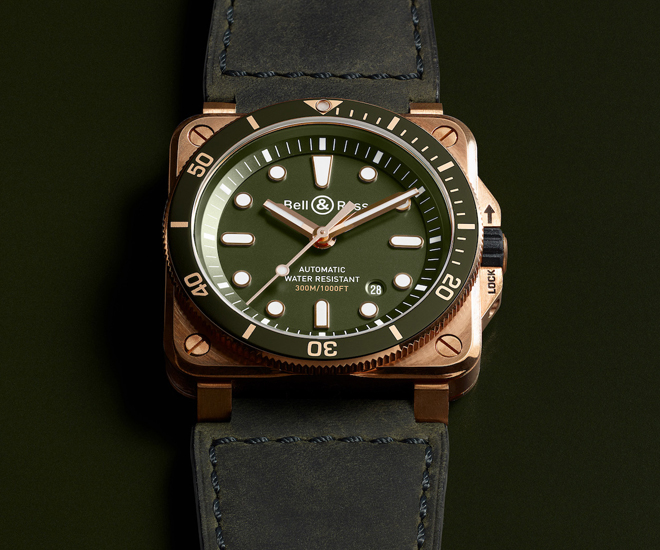
Bell & Ross BR 03-92 Diver Green Bronze Limited Edition

Contrary to popular belief, Bell & Ross did have a diving collection before the BR03 series of dive watches. If you are counting, and connecting the dots, there are three in total, including the BR03, which is the only one still in production. The predecessor BR 02 was discontinued a few years ago, but the follow-up is not only more appealling but cemented the brand’s “circle in square” design leitmotif. Hence, the diving collection as it stands after the 2017 debut reinforces the iconic BR square and functional lines but in a more nautical rather than aeronautical bent. It is worth noting that this is one of only two watches in this feature that are not round.
The Diver Bronze is the second new, if Limited Edition novelty to the Bell & Ross BR03-92 Diver collection. Clad in namesake bronze, the professional diving instrument is evocative of maritime history, referencing heritage deep sea instruments such as diving helmets. This signature element of vintage undersea exploits ala Jules Verne is immortalised via a special caseback engraving.
While most brands are content to issue their bronze diving watches in a “stabilised” form – that is to say, patinates brown instead of a “mossy” green because of its alloyed content, the Bell & Ross BR03-92 Diver Bronze achieves a more unpredictable but remarkably unique aesthetic pattern dependent not just on the environment but usage. We take this to mean that bronze used here is the more traditional sort.
That said, Bell & Ross goes beyond merely recognisable aesthetics to embody the technical criteria required of a true diving watch – the ISO 6425. Bearing features such as a minimum depth rating of 100 metres; a unidirectional rotating bezel with graduated scale; and high legibility luminescence, the Bell & Ross Bronze Diver checks a lot of boxes for a professional tool watch. When you add anti-shock and anti-magnetic protection, the rest is just icing on the cake.

Zenith Pilot Cronometro TIPO CP-2 Flyback

The Zenith Pilot Cronometro TIPO CP-2 Flyback in bronze kills two birds with one stone, figuratively speaking. No, I do not condone killing for sport. I may even become a vegetarian one day out of mercy for animals, but that would be an article for another magazine (separately, the editors of WOW do not recommend using watches as weapons, for all kinds of reasons!). What I mean by killing two birds with one stone is that Zenith made the sensible decision to satisfy two strong watch trends of material (bronze) and styling (vintage) in a single timepiece. It looks enticing, appropriate and everything, despite being outside of the diving watch genre typically associated with bronze.
Originally offered in stainless steel in late 2016, the Cronometro TIPO CP-2 Flyback is a reincarnation of a chronograph watch the company created for the Italian armed forces in the 1960s. Only 2,500 examples of the wrist chronometer (cronometro di polso or CP) were produced so the chance of acquiring a vintage specimen is slim. Going to the retailer to get the modern reissue is much easier. In any case, the CP-2 was reworked once again for Baselworld 2018, this time either in stainless steel (treated for that lived-in look) or in bronze, which is our focus for this story. This is, by no means, the only bronze offerings from Zenith, including the Type 20 Extra Special 40mm. This watch is also showcased here because, well, there’s no other space for it.
Turning back to the watch at hand, the 43mm bronze case of the Zenith Pilot Cronometro TIPO CP-2 Flyback houses the self-winding El Primero 405B chronograph movement. Beating at the frequency of 36,000 vph, it measures an event lasting up to 30 minutes with a hand at three o’clock, while supplying a power reserve of 50 hours. The brown dial itself is quite interesting to look at, with slightly recessed counters, a nice gradation from golden brown at the centre to almost black on the perimeter, and graining across the entire surface. These details can be appreciated in all lighting circumstances, thanks to the application of anti-reflective treatment on both sides of the sapphire crystal. A brown oily nubuck leather strap with rubber lining completes the casual, vintage look of this timepiece.
As elaborated by our Singapore team in the opening section of this article, bronze is a highly unusual and unusually expressive watch case material. Its recent resurgence may appear over the top – I did feel that way too at one point, with so many brands offering a watch or two in bronze – but it is just another kind of material at the end of the day, with the potential of becoming a mainstream choice not unlike ceramic and titanium before.

PANERAI SUBMERSIBLE BRONZO PAM968

Officine Panerai was one of the first watchmakers to understand the appeal of bronze to watch collectors. Well, the manufacture believed in the potential of the material, revealing its first “Bronzo” in 2011. This is what I used to call Florence-by-way-of-Neuchatel watchmaking – Panerai watchmakers are not shy about innovating, but always keep the look-and-feel consistent. Unbelievers can look to this brand’s vision of the tourbillon for confirmation of this point, but I digress. Bronze is an understandable choice for Panerai, given its rich maritime heritage, but it is not a forgiving material as far as consistency goes. In fact, Panerai is still using the CuSn8 (a straight copper and tin mix) that it used for its first Bronzo, which develops
that famous green hue as it oxidizes.
In many other ways, PAM968 echoes the first Bronzo, PAM382, including its impressive 47mm girth and the necessary titanium caseback. New for the Bronzo though is the ceramic bezel insert, which features markers in the same bronze as the case, and the automatic calibre 9010. The gradual colour shifts of the bronze material will form an interesting contrast with the evergreen ceramic; it is quite possible that those bronze highlights on the bezel might develop a different patina compared with the overall case.
Straps for this watch include brown leather and green rubber, so presumably if the oxidisation ramps up then the rubber strap will be very useful. It is actually quite surprising that more watchmakers haven’t settled on rubber as the material of choice for straps as far as bronze goes. Bronze will stain the leather strap just as it will stain fabric, or the wearer’s skin. That is why PAM968 also comes equipped with a titanium buckle, not a bronze one. While it is certainly true that rubber will compromise the vintage aesthetic it does make sense in a diving watch. In our opinion, it is actually a great look.

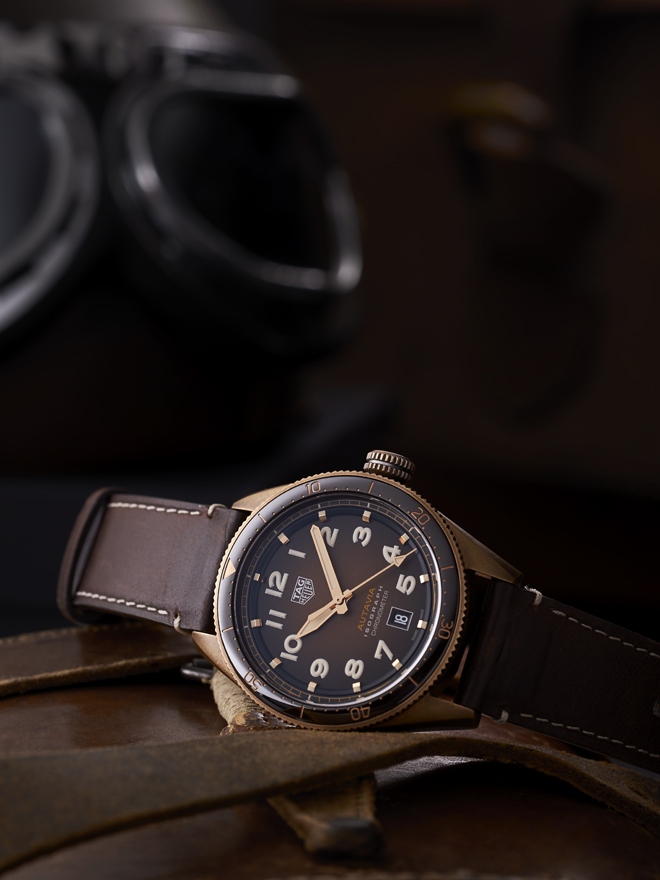
TAG HEUER AUTAVIA ISOGRAPH

Here’s a watch we’ve covered in a lot variation in this issue, thanks to converging editorial themes and cover decisions. Regardless, this watch shares important characteristics that we did not explore in the cover story. In a few words, what’s left to cover is the part TAG Heuer can play in the evolving saga of the bronze watch. When brands such as TAG Heuer, Baume & Mercier and Tudor push out bronze watches, it legitimizes what was once a niche habit. Interestingly, TAG Heuer isn’t shooting for a sort of diving watch here, even though the opportunity exists with the Aquaracer, but perhaps in future then…
The TAG Heuer Autavia Isograph isn’t solely or even primarily available in bronze. If one looks at the TAG Heuer website, you’ll have to try very hard indeed to find information about the bronze
version (we couldn’t even find bronze as a material option to filter by, as of May 2019) so perhaps this bronze watch is a sort of insider’s option. Well, it is on our cover so it is no secret, and we hear that the US site will list the option by June, when you might first read this story.
To be clear, at no point in the past did TAG Heuer ever use bronze in its cases, and bronze is not associated with the world of motoring. Some observers have tried to argue that this is TAG Heuer’s attempt to pay tribute to the aviation side of the Autavia story. As we noted in the cover story, and in issues past, the –avia part of the Autavia name is a reference to aviation. TAG Heuer itself has an aviation story but it is quite complicated and we shall ignore it for now. Of course, bronze and aviation have no relationship – bronze is about 10% more massive than steel so it is not a good fit for the business of flying anyway. The sort of copper alloy in play here is the kind with aluminium, so that makes it quite contemporary too.
Practically speaking, this means the watch will not stain the skin or your clothes, nor will it threaten the straps.

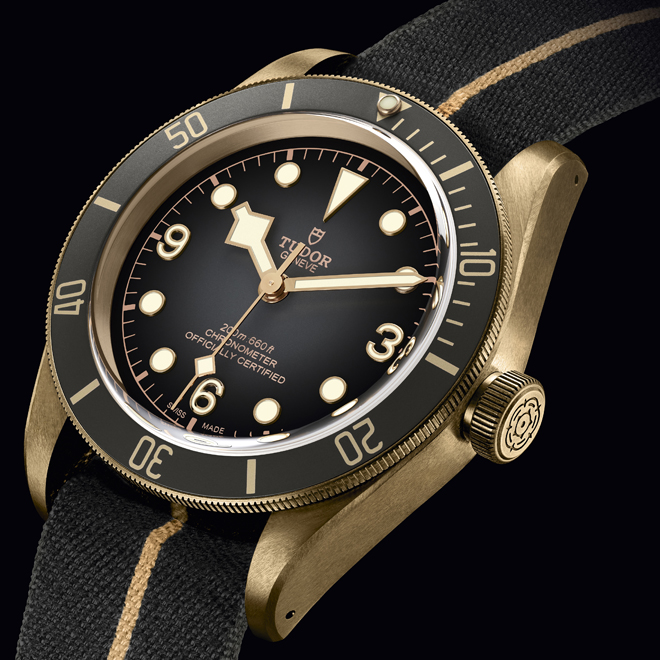
TUDOR BLACK BAY BRONZE

If Panerai gets the credit for starting the current bronze wave, and Gerald Genta is thought of as the historical progenitor of that wave, then Tudor is surely responsible for carrying the wave to the shore. Ok that entire metaphor was a bit forced, but there is certain progression in the brands when you list them – Gerald Genta, Panerai, and Tudor. All are respected names in collecting circles, although each operates (past tense in the case of Gerald Genta) in its own sphere. So, what do we make of the latest 43mm Tudor Black Bay Bronze then? The short answer is that it is a very attractive watch that might actually benefit from being a wee bit smaller. The first one 2016 also received that reaction so we are happy to concede that Tudor knows better than us. The longer answer is quite a bit more complicated, and has to do with how collectors perceive Tudor.
Leaving that perception aside for the most part, the Black Bay Bronze has provoked perplexing responses, ranging from mealy-mouthed think pieces to glowing reviews that employ dubious logic. Part of the reason for this is the fact that Tudor released the first Black Bay Bronze in 2016 to universal acclaim, so there is little more to say on the subject. The bronze in play is the same, the Arabic numerals at 3, 6 and 9 are the same, and so is the MT5601 movement. Indeed, perhaps the main thing is that critics have not learned to accept that the size is a good one, even if it means that the Black Bay Bronze is bigger and heavier than the other Black Bay offerings. We reiterate that the watch wears well, and has great wrist presence.
At the front and back of the watch, there are a couple of important points to address. The dial and bezel are new, both in slate grey, and this colour combination might be even more fetching than the old brown. As before, the nubuck and fabric straps on offer also match this grey. More than this, the dial is a graduated affair, resembling a fume dial even. As you can just make out from the pictures, the centre is lighter than the edges, contrasting again with the uniform slate grey bezel. Just google this watch and you’ll find descriptions of it echoing this sentiment (WatchesbySJX to cite just one example) so it is not just a personal whim. Flip the watch over and you will find a true rarity in a bronze watch: a steel caseback that is PVD treated to have a bronze colour. The shade of this caseback is darker than the case, and is a useful gauge for the patina this watch will develop.

ARBUTUS GUARDIAN AR-BR-01

Having covered the watch fairs for more than a decade now, I’m definitely guilty of exclaiming my surprise at some new release or other. Of course, this is mostly a case of getting carried away by the excitement of the fairs, but here’s a ticker that laid me low with a surprise dropkick. If Baume & Mercier bringing a full suite of bronze watches marked a surreal moment at the SIHH in Geneva, the Guardian series performed the same trick at Basel. Yes, Arbutus – the little brand that could – has outdone itself by creating one of the most sensible and compelling bronze watches in recent years. This 42mm automatic diving watch comes in a few versions, all cased in bronze-aluminium (similar to Tudor and Montblanc).
Unlike the watches from the aforementioned brands, this one is flying below the radar of most observers. To be fair, a lot of that has to do with brand equity, but a quick look at the watches also reveals a certain undeniable link to certain very famous sports watches. It is definitely a popular look, right down to the magnifier over the date, the unidirectional bezel, and the different colour options of the aluminium bezel insert. At 42mm, it is right in the ballpark of the most popular sizes out there.
So here’s what looks to be an entirely commercial proposition, purpose-built to serve existing demand at higher price points. The existence of something like the Guardian AR-BR-01 speaks volumes to the potential popularity of bronze watches. If once bronze was purely an option for niche brands once upon a time, it has now truly taken off. This is the reason we selected this piece for this story because while it is great to see bronze offerings from the likes of Bulgari and Montblanc, that’s almost to be expected. With Tudor or TAG Heuer, marketing dollars will be invested into generating demand for bronze watches. For Arbutus, the demand must already be there, so the place of the bronze watch as a standard, just like titanium and ceramic, must be assured.

The Fendi FFluid is a Shoe For The 21st Century Nonconformists

Celebrating the boundaryless nature of millennials, the launch of Fendi’s FFluid sneakers followed soon after the brand’s S/S2020 launch and are accentuated by chunky soles, glossy neoprene and bold color.
Dec 17, 2019 | By Julia Roxan
As cultural attitudes about gender variance have undergone profound shifts, consumers have begun to expect acceptance and equal representation across the board and in every industry… not excluding in fashion and Hollywood.

The Fendi FFluid is a Shoe For The 21st Century Nonconformists

Coining new terms such as ‘gender fluidity’, ‘agender’ and ‘non-binary’ which refer to both misgendered individuals and those who identify as more than one, society has long passed the time where specific colors, clothing and toys were reserved for one group and not the other.
While not the first to create gender-bending apparel, Fendi’s FFluid sneakers will certainly not be the last. Celebrating the boundaryless nature of millennials, the launch of these genderless sneakers followed the Italian luxury house’s Spring/Summer 2020 collection which featured ‘70s inspired items such as oversized sunglasses, flashy rings, and smooth leather bags with the brand’s iconic double “F” emblem.
Sporting edgy design elements with an arched shape and curved lines, the FFluid sneakers are accentuated by chunky soles, glossy neoprene and a technical mesh top. Incorporating a back zip for closure, the sneakers come in bold color and feature the coordinates (FENDI 41’50’N) of the brand’s headquarters in Rome’s Palazzo della Civiltà Italiana on the uppers.
Designed for comfort and daily use, the FFluid sneakers offer a boost in height with a subtle 35mm heel and are available on the official Fendi website in white, black, red and pink.

The Rules of Pairing Your Beloved Air Jordan Sneakers with Tailored Suits

both casual and sartorial clothing, creating an added edge and sense of individuality.
Dec 19, 2019 | By Julia Roxan
The Air Jordan X1 “Concord” is one of the athleisure brand’s most popular silhouettes. Returning in December 2018 for the first time since 2011, the Jordan X1 successfully blended high-level performance wear with a fashion forward design. Taking cues from traditional men’s formal dress shoes – the sneakers will forever represent a perfect storm of defining moments, design and technological innovation.

The Rules of Pairing Your Beloved Air Jordan Sneakers with Tailored Suits

Inspired by convertibles and lawn mowers, the Jordan X1 features a ballistic mesh upper, padded collar and tongue which rest atop a full-length Air unit, plus a carbon fiber shank plate and black patent leather toe box.
Synonymous with a sporty-yet-classy aesthetic, the versatile Jordan X1 is a statement piece till this day, which pairs seamlessly with both casual and sartorial clothing, creating an added edge and sense of individuality.
Along with its signature translucent soles and outsole inserts finished in Concord, the re-launched Jordan X1s sported two key elements aimed to appease enthusiasts – a high cut patent leather and heel tabs which featured the number “45” in place of the usual “23” – alluding to Michael Jordan’s brief retirement from the Chicago Bulls in 1994.

The Rules of Pairing Your Beloved Air Jordan Sneakers with Tailored Suits

Dez Bryant in Air Jordan X1 “Concord” sneakers
Ever since its inception, celebrities and sneakerheads alike have been spotted dripped to the nines… or in this case the X1’s. Whether it’s to prom, the movie theatre, sports practice, a wedding or on the red carpet, the Air Jordan X1 “Concord” has rapidly made its way from the street to the boardroom. Seen on the feet of everyone from pop stars to presidents, these Jordan’s presumably look impeccable with anything – provided you subscribe to fashion’s most basic Do’s and Don’ts.
According to a study by Harvard Business School, casually dressed people tend to appear more confident as contradicting specific dress codes, especially at work, portray an air of independence, self-importance and confidence.

Kanye West in Jordan 1 Retro High ‘Bred Toe’ Sneakers
However, for the many faking it till they make it, less formal events where jeans are acceptable are the best places to start. When pairing a pair of sneakers with a suit, consider wearing ankle socks and a casual t-shirt or collared shirt.
Avoiding ties and rocking leather, suede or canvas sneakers kept in optimal condition, is the ideal way serve looks in smart-casual outfits. One can also stylishly complete the ensemble by incorporating matching accessories and a cohesive color scheme – something which the Editor and Chief of MEN’s FOLIO, Wilson Lim believes will avoid “pushing the envelope too far” from what’s acceptable.
In contrast, to the standard Do’s and Don’ts of pairing suits with sneakers, MEN’s FOLIO Digital Editor, Bryan Goh, prefers the exact opposite. Styling inexpensive sneakers with exorbitant suits, Bryan opts for his most battered pair of shoes – creating an air effortless confidence, coupled with the appearance of “not taking yourself too seriously”.

Twirling in Time – A Brief History of the Jaeger-LeCoultre Gyrotourbillon

We take a brief look at the earlier Jaeger-LeCoultre Gyrotourbillons and the timeline of Jaeger-LeCoultre from 1833
Dec 19, 2019 | By Ashok Soman
After covering the Jaeger-LeCoultre Master Grande Tradition Gyrotourbillon Westminster Perpétuel earlier, we take a look at the history of the Jaeger-LeCoultre Gyrotourbillon.

2019 Gyrotourbillon 5; The Jaeger-LeCoultre Master Grande Tradition Gyrotourbillon Westminster Perpétuel
Although the first Jaeger-LeCoultre gyrotourbillon watch only lit up the stage in 2004, it seems the watchmakers had their eyes on this prize as early as the 1990s. At that time, watches were much smaller, with the largest watches in the Jaeger-LeCoultre assortment measuring only 41.5mm in diameter. Something like the gyrotourbillon requires a bigger stage than this, so the idea didn’t take off at that moment.
Once bigger watches began to catch fire towards the end of the 20th century, Jaeger-LeCoultre could try to come to grips with its insanely ambitious gyroscopic tourbillon plotline. The next thing to overcome was the design stage because even in the 1990s, computer-aided design (CAD) was still in its infancy – in watchmaking, almost everything was still done via blueprints. A next-generation tourbillon such as the one Jaeger-LeCoultre was proposing required CAD and 3D rendering, which also came on the scene towards the end of the 20th century.
Stephane Belmont, then International Marketing Director and currently Heritage Director, told the FHH magazine that “progress in CAD and the development of 3D renderings were absolutely decisive.”
“The original concept was for the balance to pivot in every dimension, not just vertically,” said Belmont. “There was never any question of modifying a conventional tourbillon by adding new axes. For it to work, we had to devise a complete system and ensure perfect equilibrium between the perpendicular axes and the different parts. Hence the need for a simulation program. The balance spring must have a pre-defined shape and, once in place, cannot be altered. Because of its constantly changing angles, it’s impossible to calculate a mean for the various positions as we normally would. This type of system where the escapement is always moving is also a guarantee of precision as amplitude remains absolutely constant.”
To manage the delicate yet vigorous act of having the balance pivot in every position, the watchmakers developed a tourbillon that could rotate on two perpendicular axis. If one is counting, that simply means there are two axes in play here. In the current and the original Gyrotourbillon, the outer carriage of the gyroscopic tourbillon rotates in one minute, while the second twirls faster –completing a circuit in 24 seconds. The speeds of the various rotations might vary but this is typically how the multi-axis tourbillon works, as Jaeger-LeCoultre demonstrated in 2004 (Gyrotourbillon 1), 2008 (Gyrotourbillon 2), 2013 (Gyrotourbillon 3), 2016 (Gyrotourbillon 4), and finally 2019 (Gyrotourbillon 5).
Jaeger-LeCoultre from 1833

Design a site like this with WordPress.com
Get started