A Sporting Chance — a Deeper Dive into the Unprecedented Demand for Steel Sports Watches

The steel sports watch rules over watchmaking at all levels, but especially at a certain threshold of exclusivity. We examine the reasons for the unprecedented demand for this type of ticker
Dec 24, 2019 | By Prince Chahal

Rolex Oyster Perpetual Submariner
This is a story that insisted on being told. It emerges from a question that does not need to be asked, but plenty of people discuss it anyway. In short, it concerns the appetite for luxury sports watches, and certain design sensibilities that define said watches. Was the desire for such watches always there, or did watchmaking firms create the demand? To put it another way, using a more relatable and entirely plebeian example, did people always want the Internet or is it merely a tool that people took to? As you might guess, asking the sports watch question certainly gets interesting answers, but the entire affair seems academic.
The trouble of course is that there is no such thing as a luxury sports watch, and there exists no working definition for it. It is certainly not necessarily round, nor must it be especially robust; it need not even be in any particular material. Paradoxically, the luxury sports watch is very much a real thing, and virtually every brand has one watch that approaches some sort of ephemeral ideal. All of this amounts to lots of waffling and pointless pontificating, which does not make it an attractive story to pursue, objectively.

The A. Lange & Söhne Odysseus, launched on 24 October 2019, opens up a new chapter for A. Lange & Söhne. It lays the foundation for a further watch family: the sixth one. For the first regularly produced timepiece in stainless steel, the Saxon watchmakers developed a tailor-made self-winding movement with a large day-of-week and date display.
What finally made this story a reality for WOW was the release of the A. Lange & Söhne Odysseus watch recently. The brand had shown select parties the watch earlier in the year, and so in the end everyone was just waiting for the news embargo to lift. The moment we published online, everyone else did too – this is truly a watch that created a news cycle entirely via manufactured means, since no one broke the story early. This release pairs well with Glashutte Original’s most important new release of 2019, the SeaQ Panorama Date. The watch is charmingly utilitarian, but that big date offers a sly wink at contemporary tastes for date windows, even when too small to be useful. It can also be viewed as challenge to the Rolex Submariner models with date, but more on that later. 
So, what is notable now is that every brand, from Patek Philippe and Audemars Piguet to Vacheron Constantin and Breguet has a steel sports watch in play. Intriguingly, none of these brands follows a particular standard, with Patek Philippe even celebrating the 40th anniversary of its icon, the Nautilus with precious metal versions. Even neighbours such as A. Lange & Söhne and Glashutte Original have chosen very different approaches.

First Submariner, 1953
Obviously, the king of the luxury sports watch hill is Rolex, as you can guess just from looking at this story, and the Geneva brand does not shy away from precious materials for its Professional watches.

CAVEAT EMPTOR

One of the key points about the luxury sports watch is the bracelet. For this story, even though we are saying bracelets are a prerequisite, we are not suggesting what sort of bracelet it should be. This is contentious because some models, the Patek Philippe Golden Ellipse for one, are available with integrated bracelets but are certainly not luxury sports watches. Of course, then there is the matter of the integrated bracelet, but that seems a subject for a story on its own. There are so many types of bracelets, and indeed straps, that a different kind of story would work better to address this aspect.

Panerai Luminor 3 Days GMT Power Reserve PAM347
Then there are brands such as Panerai, Hublot and Blancpain that have very sporty watches but whose bracelet models are arguably not extraordinarily popular. In truth, the Blancpain Fifty Fathoms, is a seriously attractive watch, and the Annual Calendar model in steel should be considered by anyone who is dreaming of the Rolex Sky-Dweller, for example.
The Breguet Marine collection also sports a relatively new option, with bracelet this time, and we look forward to addressing this piece in greater depth. This collection made a big splash last year with a total overhaul of all models; this year, Breguet adds a full titanium piece to the list, with matching bracelet. That bracelet really makes the difference, but the Roman numerals make the watch a bit more dress than sports, but we digress.
As for Panerai, it can be argued that every watch made by the brand is a luxury sports watch yet bracelets are not its stock in trade. The firm does have very distinctive Arabic numerals and very clear dials that burnish the sports watch credentials of the entire range. We are including some examples from the above-mentioned brands as alternatives to the dominant voices here, but we are purposely ignoring classically styled watches that happen to have beautiful bracelets, whatever the nature of those bracelets.

Vacheron Constantin Overseas Chronograph
Honourable mention must also be made of the Vacheron Constantin Overseas and the Piaget Polo S, which are only mentioned in passing here. The Jorg Hysek-designed Vacheron Constantin 222 eventually evolved into the Overseas in 1996, and represents a highly influential, if underrated luxury sports watch. As for the Piaget Polo S, it is a direct descendant of the Yves Piaget-designed polo watch, which was peak 1970s design – an era that defines and presages the current ascendance of exclusive bracelet watches of all kinds.
At this point, a small personal confession is required. Long-time readers will know that I’ve been craving (a word I do not use lightly) a Rolex GMT-Master II in steel for some years – the blue-and-red version with the Cerachrom bezel, known colloquially as the “Pepsi.”
After years of being frustrated and thwarted, Rolex finally made the watch last year but my initial joy dissipated once I saw the wait list. In many ways, that is the real reason this story exists; that it exists in such length is just down to the fact that I am the editor of this magazine. Yes, this is a long read so settle in for plenty of pointless pontificating (my favourite sin, if my detractors are to be believed).

Rolex Oyster Perpetual GMT-Master II
Now it is certainly not news that Professional model watches from Rolex are sometimes hard to come by (collector Winston Kwang weighs in on this elsewhere in this issue), new from authorised sellers. Even some models of ultimately disposable mobile phones are hard to buy brand new. We can attribute the rush to buy the latest iPhone to people’s lust for shinny new objects, largely because if you wait long enough, things cool down and you can get pretty much any phone you want. Steel sports watches from certain brands? Good luck with that, because even the most prolific maker of luxury sports watches isn’t quite on the production level of Apple or Samsung. Ironically, this is exactly what we like to see from makers of luxury watches because who wants products that are brought to market flawed (exploding batteries anyone?). It begs yet another question though: why only sports watches? Are people – meaning men – just not interested in dress watches then, or is the tendency for men to seek out sports watches that can also work in more formal settings?
We will not pretend that this article will provide answers to the big questions, but it might shed some light on why certain kinds of designs hog all the limelight.

CIRCULAR REASONING

There is something magical about a circle, even from a purely mathematical perspective. I recall being mesmerised as a child by the idea – the fact really – that the ratio of any circle’s circumference to its diameter is always the same: Pi. So the biggest circle has the same ratio as the smallest, and that is just mind-boggling. Even more amazing is the fact that Pi is an irrational number, and thus its decimal representation both never ends and never repeats the same pattern. This is just a fact about the natural world, and seems to my feeble mind an indication that there is something fundamentally wrong with mathematics.
What this means is that if you have a timepiece with a round face (and you likely do) then you in fact own an impossible object.
If you are a watch collector then you may have looked at six impossible objects before breakfast, to appropriate a little from Lewis Carroll (himself a mathematician besides being the author of Alice in Wonderland, among other things).
It is not known where, or how, time got into this picture, vis-à-vis the circle of life and such. The arrow of time is, after all, a more accurate cliché than the circle of life, although Ted Chiang made the most excellent use of circular time in his novella The Story of Your Life. Travelling back and forth in time is, theoretically, possible as long as one does not mess with causality. This works out nicely when you have to set your watch back, for example. Think of it this way: for a stationary observer, a second that passes is indistinguishable from one that is to come. You are not at any one point, but if you stop and look, that is where you are. Yes, everything is about Buckaroo Banzai in the end.

The Wheldrake Sundial taken in St Helens church in Wheldrake, York
Clearly, time as a circle forms the grammar of watchmaking design, and this is certainly not a new thing. The sundial was a preview of the display of time, and clearly showed certainly natural advantages to the design – it is easier to read, and doesn’t induce anxiety the same way an hourglass does. By the time clocks rolled around, the circle was well-established as the design of choice for the display of time. As far the shape of the clocks went though, these varied greatly, but always revolved around keeping the clocks upright. The pendulum clock design by Christiaan Huygens required the device to be as stable as possible, and immobile of course.
Round shapes are famously unstable and rather more suited to mobility, which might explain why this was the shape of choice for the pocket watch. Even a cursory examination of the Patek Philippe Museum or the archives at Breguet reveals nothing but round pocket watches, which is very impressive; no serious treatises have been published on why this might be so. Perhaps it is because time is famously described as a wheel (making arrow-shaped timepieces might have been impractical), or because clock faces were round. Whatever the case, we only bring this up because the pocket watch was designed to bring a sensitive instrument out into an inherently dangerous world, with the expectation that it will work just fine.

FROM THE POCKET TO DAVY JONES’ LOCKER

Alternatively, pocket watches somewhat resemble lockets, what with the hinged cases and such. As products, lockets and pocket watches were contemporaneous, both dating back to 15th century Europe; the first pocket watch is credited to Peter Henlein of Nuremberg, Germany while the locket is of uncertain origin. Again this was well before miniaturisation (and Huygens) got clockwork to the point that a timekeeping device could follow us around, keep time accurately, and be exposed to potential shocks and other perturbations. This is not to say that robustness, precision and accuracy were not important to people at that time, but they made do with what they had. Certainly, none of the tickers right up to the 20th century were water-resistant.
Well, the circle certainly represents a key phase of timekeeping design language for a reason related to the aforementioned special properties of the shape. From the centre of a perfectly circular dial, every point on the circumference is equidistant, as implied in our earlier math digression. This makes it easy to accurately track and display the progress of time with traditional hands. The advent of the automatic wristwatch also favoured the round shape, just by virtue of the rotor – it is unsurprising that the first quartz watches busted the bounds of the round watch almost immediately. Quartz or no, water-resistance is one area that the round watch still shines, though the makers of pocket watches could not have known this (rubber was unknown at that point). Even haute horlogerie enfant terrible Richard Mille agreed when it released its first proper diving watch, the RM25.
Offering a telling counterpoint is Bell & Ross with the BR03, which stuck with the iconic shape that co-founder Bruno Belamich pioneered, but with a round unidirectional bezel. This of course brings this story, prematurely, to the BR05, which is quite a different beast to the aviation-skewed Bell & Ross assortment. We will be looking into this piece alongside the notable new luxury sports watches this year, including the aforementioned Odysseus, and the Chopard Alpine Eagle.
It must be noted here, for the record, that there are many new luxury sports watches, including models from brands as varied as Urban Jurgensen, Nomos Glashutte, and Rado, and we cannot feature all of them here. This is true even if we exclude all the Submariner ‘homages’ and straight-up diving watches. Indeed, not every sporty watch is a sports watch, as far as the current trend goes. After all, the hot segment includes the always-popular-but-never-available Audemars Piguet Royal Oak and the Patek Philippe Nautilus, neither of which are really sports watches in the way that a Rolex Submariner, an Omega Seamaster, or the TAG Heuer Autavia is.

A MATTER OF FORM

Girard-Perregaux Laureato case
Using time is exactly where this story is going, specifically why the luxury sports wristwatch is objectively desirable and lusted after by everyone. Just as reality is not at all dependant on time, the appeal of the sportswatch has nothing to do with timekeeping. There are various arguments made for the lasting appeal of the sports watch (of any kind), including reliability and robustness, but these falter in the face of compelling design. One need only look to successful designs from the past to see this in action. The Cartier Tank has a long and storied history from its debut in 1908, but it remains in the current collection, which is a testament to the long-term visionary powers of Louis Cartier.
Even in the case of the mighty Rolex Submariner, one of the most popular sports watches (of any kind) in the world, one could argue that it is the design of the watch that carries the greatest appeal. That is to say, it looks right and works right besides, to such an extent that even Hodinkee ventured to suggest that it might be the most important watch of all time. To be fair, when considering the “most important watch,” the Rolex Submariner definitely comes to mind – the watch successfully predicted what people wanted in a sports watch, and then proceeded to define it. The entire global watch industry went all in on the Submariner’s trademark looks. Today, this is what one simply expects a sports watch to look like.
When it comes to the strength of the form-and-function argument, it does not get better than the date model with the Cyclops lens. Sticking a little magnifying glass onto sapphire crystal to amplify the date might seem wonky but it works for the Submariner to such an extent that there are plenty of regular folks (not you) who think there is no such thing as a no-date Submariner. The more impressive illusion here is that Rolex Oyster Perpetual watches are round. Studying the profile of any given Oyster Perpetual reveals an essentially barrel shape, otherwise known as tonneau in watchmaking parlance.
It is possible to go on, without limits, about the Rolex Submariner, especially given the heated state of the luxury sports watch segment, but that is not what this story is about. Instead, we wanted to zoom on the aforementioned ephemeral ideals that the luxury sports watch represents. Before we look at the selection of watches, here is the tl;dr to this rambling introduction.
A luxury sports watch needs to be priced appropriately – there appears to be no ceiling but the appearance of exclusivity is a must.
Similarly, the watch needs to be robust, but it need not be a pure tool watch. It needs to be the sort of watch that you could swim with, and not worry about. Generally, the watch should also be an automatic, which means it will most likely be round, but it can certainly be quartz.
A compelling design is absolutely necessary, and there appear to be no constraints here. In fact, a truly strong design means the watch has more wiggle room in the robustness stakes. Chunkiness is a virtue, despite Gerald Genta’s original goals.
Without further ado then, here are the watches that illustrate all the above points, including a few surprise left-field inclusions.

WITHIN REACH

Just as the extreme luxury sports watch exists, so too does the regular sports watch. Perhaps no brand has made a virtue of demonstrating amazing performance in a virtually indestructible watch as G-Shock. In a way, a G-Shock watch, like the GA-2100 with its Carbon Core Guard structure, is the Richard Mille of the affordable segment – even in this segment, availability can be absurd. As an aside, the GA-2100 sports an octagonal bezel, so the spirit of Gerald Genta continues to make itself felt! But the G-Shock is not mechanical, I can almost hear you silently scream. But mechanical movements are not a must here, and G-Shock does have metal bracelet models…

G-Shock GA-2100 with the Carbon Core Guard structure
Ok, on the matter of performance, let us look within the watch too. Here is where the new TAG Heuer Autavia Isograph comes into play, because it has a band new carbon composite hairspring – this is something no other watchmaker has. The significant nature of this model means we feel it will be highly collectible, and indeed may no longer be available at stores thanks to this.
Back on point, when a brand’s offerings are somewhat favoured by collectors, individual models tend to sell out – and brands do not react to resupply. This has happened before, most famously with the Swatch watch, which was at that time a total novelty. Collectors bought up certain models, and were basically acting like hoarders. The company that would become Swatch Group reacted by ramping up production, destroying any notional resale value (although it can be argued that the original series watches, first editions as they are, are still valuable), thus putting an end to the roaring second-hand trade in Swatch watches.

TAG Heuer Autavia Isograph
Returning to the example of mobile phones, it seems evident that one cannot simply produce as many products as needed to accommodate all levels of demand. Nevertheless, it remains true that you will always be able to get a super-tough G-Shock or a sporty Swatch by just walking into a store, or shopping online. With that in mind, here are a few options that we know are still available and may well be worth looking into.

TUDOR NORTH FLAG

Not obviously a heritage watch, though it is inspired by the 1970s Ranger II, the Tudor North Flag is currently still underappreciated, if not overlooked entirely, in favour of the Black Bay series. This represents an opportunity to snap up a truly interesting watch – it sported Tudor’s first in-house movement in 2015, and still presents very differently compared with the rest of the range. Also, it has an exhibition caseback, which is highly unusual for Tudor.

SEIKO 5 SNXM17J5

One of three smaller watches in this feature, overall, this 35mm reference from Seiko surprises with its positively Bauhaus leanings. The SNXM17J5 is more handsome than its forgettable name suggests, and makes an impression despite its relatively diminutive stature. Alternatively, there’s also the new 42mm Seiko sports watches (pictured above), specifically those models with the beefy steel bracelets. These have more of the typical luxury sports watch vibe.

RADO CAPTAIN COOK

Another sports watch that rocks a variety of sizes, from 37mm to 45mm, the Rado Captain Cook also offers a more standard 42mm offering. The size is one thing, but, as noted elsewhere in this issue, it is the sunburst dials that draw the eye in. The green is very on-trend, but should stand the test of time.

MAURICE LACROIX AIKON

Looking like it was drawn out of the 1970s playbook, the Maurice Lacroix Aikon is in fact inspired by a 1990 watch. A full collection with many variants, the strong styling of the case pairs with an excellent fit and a surprising degree of flexibility (there is a quick-change option even for what looks like an integrated bracelet).

Precision Instruments – Jaeger-LeCoultre Master Grande Tradition Gyrotourbillon Westminster Perpétuel

Jaeger-LeCoultre reminds the world why it is called the Grande Maison with the Master Grande Tradition Gyrotourbillon Westminster Perpétuel, and a few other notable complicated watches
Dec 24, 2019 | By Prince Chahal

Jaeger-LeCoultre Master Grande Tradition Gyrotourbillon Westminster Perpétuel Image by Ching/GreenPlasticSoldiers
There’s a largely forgotten but relatively recent riddle in fine watchmaking. It made the rounds in 2009, and it goes something like this: how many tourbillons does it take to make the hands of time go round the dial? The answer is anything but straightforward, but it takes the form of a few follow-up questions. If haute horlogerie is your thing then you may find these hilarious.
  • Answer number 1: By tourbillons, do you mean toinclude karusels and carrousels too?
  • Answer number 2: Will the tourbillons be single or multi-axis?
  • Answer number 3: Are the tourbillons inclined?
  • Answer number 4: Wait, do we actually need tourbillons of any kind (or karusels for that matter) to keep good time in a wristwatch?
  • Answer number 5: Just kidding, we need as many tourbillons as possible, with as many axes as possible. Obviously, these will all be inclined at every possible angle. In fact, we don’t need hands, dials, or even cases. What we need is lots and lots of tourbillons. Or anything that can pass as a tourbillon. Even a karusel.
That last one is the punchline, although the whole thing works as a bit of a light-hearted jest, if one is so inclined. On a serious note, it all makes sense when you think of the tourbillon as a marketing story; a way to tell and sell the story of mechanical watchmaking. Funnily enough, 2009 was also the year that a storied name in Swiss watchmaking decided to make a strong statement about the tourbillon. The manufacture was Jaeger-LeCoultre and the watch was the Reverso Gyrotourbillon 2, which beat out its field of competitors in a proper independent chronometry competition. The Concours International de Chronometrie may be no more, and it certainly had its failings, but this episode did highlight the fact that a tourbillon could play a valuable role in improving the accuracy of a mechanical wristwatch.

Close up of the gyrotourbillon
Quite obviously then, the aforementioned riddle is a jab at the marketing hype that, more or less, dominated the conversation about fine mechanical watches. Undercutting the hype though are facts such as the triumph of Jaeger-LeCoultre in the chronometry contest. Making the case a little stronger for tourbillons in general, Jaeger-LeCoultre was actually recognised for another tourbillon watch in the 2009 competition: the Master Tourbillon (part of the Master Control collection). Over the years, this particular automatic tourbillon movement has become something of an industry standard for reliability and precision. It is also a standard for Jaeger-LeCoultre, and is part of the collection this year, as you will see.
The key point here is that the tourbillon is only as good as the watchmakers behind it, and the brand philosophy behind them. This point defines what the manufacture Jaeger-LeCoultre brings to the table in terms of its complicated wristwatches, at every level.

The Vallee Beyond

A watch such as the one on our cover this issue, which is covered in more detail elsewhere this issue, tells you everything you need to know about the Le Sentier manufacture’s technical and artisanal competencies just at face value. We were lucky enough to shoot the watch at the SIHH this year, and our friends at WOW Thailand actually featured it on the cover of their Pioneer issue (the equivalent of our Summer issue). Here’s how that story, by editor Ruckdee Chotjinda, tells it: “With over 400 patents across nearly 1,250 calibres, Jaeger-LeCoultre is undoubtedly a true manufacture from the Vallee de Joux – one that strikes the perfect balance between technical prowess and aesthetics.”

Gyrotourbillon cage
The aesthetic qualities the story refers to can be seen most clearly in the solidly classical dial, which features both guillochage and enamel work. The guilloche decoration is done by hand, and when completed the grand feu enamelling follows. The result is a bewitching dial that does not reveal the trade secrets behind its magical appeal. This subtle approach contrasts starkly with the gyrotourbillon and the chiming mechanism, which are both crafted to hold the eye, and to invite speculation on how they work.
Happily, one need not engage in much speculation about the watch and the distinguished calibre 184 that powers it. This manual winding movement is extraordinarily precise, gaining or losing just one second per day. To put that into perspective, to qualify for the industry-leading COSC standard, a mechanical movement need only stay within the -4/+6 seconds per day range. Jaeger-LeCoultre has guaranteed this precision right from the start of the gyrotourbillon story so this is not a surprise. This means that every gyrotourbillon watch from the Master Gyrotourbillon in 2004 onwards boasts this precision. It is this commitment to an excellent timekeeping rate that won Jaeger-LeCoultre the top plaudits at the 2009 chronometry prize.

Desgin sketch of the Master Grande Tradition Gyrotourbillon Westminster Perpétuel
Precision is a big part of the Jaeger-LeCoultre story, as CEO Catherine Rénier reminded us at the SIHH this year. “Precision is at the core of the history…and the business of Jaeger-LeCoultre. It has always been a balance between innovation and the search for precision. Our entry into the world of watchmaking began at simply trying to improve the components of the watch and each calibre beginning with the pinions.” Renier was referencing the manufacture’s invention of the millionometre in 1844 (see the timeline infographic), an achievement it made long before any watches would bear the name LeCoultre.

Chimes at Midnight

Precision even marks that most soulful of complications, the musical rendering of current time. In the Gyrotourbillon 5, an unlikely mechanism has been given a part in the orchestra: the remontoir d’egalite. As covered more fully in our story about constant force mechanisms this issue, the remontoir keeps the energy-hungry gyrotourbillon fed with a steady supply of power (calibre 184 has a power reserve of 52 hours, which given its energy consumption implies a rather large barrel). A powerful mainspring also explains the use of the remontoir as this device can protect the sensitive escapement from the full force of the power supply.
It just so happens that the remontoir is ‘recharged’ by the aforementioned mainspring every minute, and – because it controls the second wheel – this means the minute hand moves in discrete steps, rather than creeping forward. This arrangement explains how the chiming mechanism is more precise in sounding out the minutes; even when the repeater is activated between two minutes, it will still sound out the time down to the correct minute.

Close up of the minute repeater hammer and patented crystal gong
This brings us to the Westminster chimes, which basically means this is a Big Ben clock on the wrist. Normally, minute repeaters sound out the time with tones denoting the hours, quarters and minutes in a one tone, two-tone and one tone pattern respectively. While beautiful in this simple ding, ding-dong, ding style, Westminster chimes are infinitely richer. What one hears when activating the minute repeater here is a complex four-phrase melody consisting of four notes. See the cover watch story for more details on this. We also recommend Googling Westminster chimes for a recording of what it sounds like.
On that note, the Master Grande Tradition Gyrotourbillon Westminster Perpétuel is about much more than accuracy, as its name clearly states! There’s a reason the watch’s complications are laid out so compellingly, and that there isn’t a seconds hand or counter. There are no less than 12 patents at work here, two of which are new – for the perpetual calendar and for the minute repeater. There is a story to this watch – an emotional narrative about timekeeping that has as much drama as Orson Welles’ The Chimes at Midnight. Indeed, in 2009, when the news was all about technical competency of the manufacture that had so recently produced so many wonders, then-CEO Jerome Lambert (now Richemont CEO) surprisingly turned the conversation to the personality of the Reverso Gyrotourbillon.

Jaeger-LeCoultre calibre 184
Jaeger-LeCoultre CEOs waste no opportunity to remind journalists that the Grande Maison has mastered every complication and every trick in the watchmaking book, and that its 1,000-plus employees can deploy any horological skill at will. When Lambert was talking about the emotional power of the gyrotourbillon, he might as well have been referring to the fact that the watch was the physical embodiment of the manufacture’s history, traditions and creativity. This is true of every Jaeger-LeCoultre watch but a grand complication, or a bona fide superwatch like the Gyrotourbillon Westminster Perpétuel, puts all the virtues of the manufacture on show. It certainly feels like the gyrotourbillon series of watches, and the Hybris Mechanica for that matter, are all principal players in a grand play about space-time, written and directed by the manufacture Jaeger-LeCoultre.
Insofar as the looks of the watch paint a picture of complexity and subtlety, Jaeger-LeCoultre continues its tradition of using the gyrotourbillon as the pinnacle of its capabilities. “The Gyrotourbillon is the highest expression currently – the gearwork is visible, as are 90 cuts on the enamel, and several executions of each line to create the guilloche. I don’t know what’s the most challenging when this timepiece exists,” said Renier.

All the Bells and Whistles

It is indeed difficult to imagine making a more challenging and technically competent watch, especially in such a compact form; when we saw the Gyro 1 and the Gyro 2 in the metal, as they say, the girth of the watches was not trivial. In the latest gyrotourbillon watch, the fifth such creation, no effort was spared to reduce the size of the gyroscopic tourbillon that gives the Gyrotourbillon series its name. Indeed, the Gyrotourbillon 4, the Reverso Tribute Gyrotourbillon already displayed the manufacture’s commitment to making watches with this complication more wearable.

Caseback of the Jaeger-LeCoultre Master Grande Tradition Gyrotourbillon Westminster Perpétuel
The new watch is a not inconsiderable 43mm across but just 14mm thick. That’s just about 4mm thicker than the Master Ultra Thin Moon Enamel, also featured in this story, and 2mm thinner than the Gyrotourbillon 1. The watchmakers played their part in making this new compact aesthetic possible in the Gyrotourbillon 5 by reducing the size of the gyroscopic tourbillon by almost 15%, by means that include the manufacture’s famous Duoplan escapement. Making the tourbillon smaller also means that it has a lower tolerance for errors, thus providing yet another reason the manufacture decided on a remontoir here.
Precision is at the core of the history…and the business of Jaeger-LeCoultre. It has always been a balance between innovation and the search for precision
– Catherine Rénier, CEO Jaeger-LeCoultre
After the era of the grand superwatches such as the Gyrotourbillon 2, the Master Grande Tradition Gyrotourbillon Westminster Perpétuel represents the new frontier in haute horlogerie. For example, it is the first watch in the world with a multi-axis tourbillon, constant force mechanism, Westminster chimes and perpetual calendar. In fact, this is the first time Jaeger-LeCoultre has deployed a remontoir d’égalite.

Precision is an Art

It goes without saying that there are other important watches from the manufacture this year, where the observant can also find the tell-tale signatures of the manufacture. Some of these require a closer look in future issues, or have been singled-out already, such as the Master Grande Tradition Répétition Minutes Perpétuelle (issue #53). A particular favourite of more poetic souls would be the automatic Master Ultra Thin Moon Enamel, which gives pride of place to the one calendar indication that the Gyrotourbillon 5 could not make space for: the moon phase. Connoisseurs will recall that this is not a new watch, with calibre 925 powering several models, including women’s versions. What’s new here is something the watch has in common with the Gyrotourbillon, and the other mainstays of 2019. We are referring of course to the enamel dial.

Jaeger-LeCoultre Master Ultra Thin Moon Enamel
Indeed, the enamel dials also remind us that this particular artisanal touch – so easily overlooked by the impatient – has been making waves at the manufacture all along. As noted elsewhere, and reiterated by Rénier, this thoroughly amazing dial could only have been produced in such uniformity and variety by a manufacture with enough depth and strength to have mastered more than 180 skills in-house. Yes, dials can exhibit both uniformity and variety, especially the dials of these new timepieces from Jaeger-LeCoultre.
One 2019 watch in particular that makes a good fit alongside the Gyrotourbillon 5 is the Master Ultra Thin Tourbillon Enamel. Yes the dial is yet another example of Jaeger-LeCoultre’s superlative dials. For a moment though, we find ourselves needing to state that this watch is essentially identical to the 4Hz Master Tourbillon that also triumphed in 2009 chronometry prize. The new watch is powered by the same calibre 978 that brought home the bacon in 2009 for Jaeger-LeCoultre. In 2019, the movement has been tweaked to include a date indicator at 12 o’clock that acts as a nice counterweight to the tourbillon at 6 o’clock. We shall definitely be making space for this watch in Highlights soon.

Jaeger-LeCoultre Master Ultra Thin Tourbillon Enamel
Closing things out for 2019 novelties is the Master Ultra Thin Perpétual Enamel, which allows us to note that there are three different perpétual calendars in the Jaeger-LeCoultre assortment this year. Intriguingly, each one has its own particularities and perhaps that is why they each spell the word “perpetual” differently.

Ritzy Animation’s Piercing RED Christmas Film Embraces Rudolph’s Darker Side

RED is Ritzy Animation’s first ever in-house short film, which details an epic story of redemption through Rudolph’s zero to hero ‘career’ moments
Dec 24, 2019 | By Prince Chahal
Conceptualized two years prior to its final release, RED is Ritzy Animation’s first ever in-house short film, which details an epic story of redemption through Rudolph’s highest and lowest ‘career’ moments. Created just for the fun of it, the film was an ‘after-work’ project developed alongside the studio’s other commercial assignments.

Ritzy Animation’s Piercing RED Christmas Film Embraces Rudolph’s Darker Side

Once the most talented and revered reindeer on the sleigh, the first 30 seconds of the film establish Rudolph’s detrimental lifestyle and his eventual downfall – exposing a darker side of the popularized Christmas character.
From hero to zero, and back to hero, RED is the anti-hero we can’t help but root for. Designed with a striking silhouette, RED is a beefy character, oozing with power, class and an element of rebelliousness – straying away from typical festive traditions and representations of an overtly joyous Rudolph.
Despite a build inspired by bulls, Teen Wolf, bodybuilders and ancient Greek mythology, RED does not appear hostile and his tireless determination is endearing.
With every detail from the brand of cigarettes to the display magazines and even the consistency of RED’s fur, meticulously researched, this 3D animation represents Ritzy’s effort to both hone its skills as a studio and create new attainable benchmarks for future work.
Directed by Two Jeffs, the film’s was successfully rendered with the help of cloud-based software company, YellowDog and made its official world premiere at a Ritzy Cinema event in Brixton on 17th December 2019.
All images are by the London-based Ritzy Animation Studio

Boeing CEO Muilenburg Ousted to restore Confidence in Boeing as FAA Hearings continue over 737 MAX safety issues

From removing lightning protection on 787 to flawed design of the 737 MAX, ouster of Boeing CEO Muilenburg is little cure for company culture
Dec 24, 2019 | By Prince Chahal

Boeing 787 Dreamliner
Making its first passenger flight in 2011, the Boeing 787 Dreamliner has been fettered breathlessly by international media like CNN and The Telegraph as the future of flight. Carrying  an estimated 250 travelers from Tokyo to Hong Kong via Japan’s All Nippon Airways, the 787 Dreamliner, boasting state-of-the-art design, an intuitive cockpit, innovative Head-Up Piloting Display and electronically dimmed windows, saves its best for last – upending 60 years of modern aviation with one revolutionary update: Use of composite materials like carbon fibre-reinforced polymers. Eschewing traditional aluminium parts for the wings and fuselage; all par course for Boeing’s “future of flight” aspiration but what they didn’t tell US Federal Aviation administrators is that they were doing away with another traditional hallmark of aviation safety as well – lightning protection.
“It appears FAA specialists believed Boeing’s design change failed to comply with Special Condition 25-414 SC, which requires Boeing to show that a fuel tank ignition would be extremely improbable,” – Peter DeFazio, the chairman of the U.S. House Representatives Transportation and Infrastructure Committee to the FAA administrator Stephen Dickson

CEO Muilenburg Ousted to restore Confidence in Boeing as FAA Hearings continue over 737 MAX (and now 787 Dreamliner) safety issues

Boeing 787
During the second week of December 2019, concerns arose from the US Federal Aviation Administration engineers that Boeing 787 Dreamliner wing design changes and other assorted modifications, including the removal of copper foil from the wing, made the Boeing plane prone to damage from lightning strikes.
That said, in most instances, scientific principles meant that lightning, following the path of least resistance, is conducted across the aluminium surfaces of the aircraft away and around the vital components and then it exits into the atmosphere, having traversed the metal body of the plane harmlessly, leaving only some metal scoring and carbon in its wake.
In some rare instances, lightning strikes cause a lot more damage than anticipated and in 1967, it precipitated a fuel tank explosion which caused the deaths of everyone on-board, becoming a catalyst for vastly improved protection techniques and rigorous lightning safety certification. Now it appears that after over four decades of roughly incident-free flying (at least when it comes to lightning), Boeing is  to cut a few corners, in the wake of a growing 737 Max debacle.

Boeing removed lightning protection features from 787

Peter DeFazio, chairman of the U.S. House Representatives Transportation and Infrastructure Committee has written in a public letter to the FAA administrator Stephen Dickson stating that, “It appears FAA specialists believed Boeing’s design change failed to comply with Special Condition 25-414 SC, which requires Boeing to show that a fuel tank ignition would be extremely improbable.”
With an aircraft as  materially advanced as Boeing’s 787 Dreamliner, the propensity for lightning related damage increases with the lighter, stronger, carbon fibre-reinforced polymers since lightning does not conduct across its surface harmlessly as it does aluminium. According to The Seattle Times, “the problem arises from the fact that wing fasteners are no longer fault tolerant because of the removal of the copper foil indicating that 90% of the fasteners became a single point of failure with the potential to become an igniting point in the event of a lightning strike”.
DeFazio raised concerns back in November 2019 but Boeing had already made these modifications to the wing for at least 40 Dreamliners before FAA approval. Alarmingly, the design safety investigations were not the multinational corporation’s first run-in with authorities, and certainly not the last. Other issues included the 787’s defective oxygen systems and of the now widely publicised 737’s faulty flight-control systems.

Boeing’s Production Issues and Shortcuts

Former Boeing quality manager, John Barnett
Boeing’s former quality control engineer, John Barnett told BBC that he had reported to the FAA that he had tested 300 new oxygen systems in 2017 and discovered a 25% failure rate. The Federal Aviation Administration however, eventually dismissed the complaint, following Boeing’s indication to fix the issue despite installing defective parts into the final assembly line of North Charleston in South Carolina. The 32 year veteran who had retired in 2017 also made allegations saying that scrap parts were installed on new aircraft as well, mirroring a New York Times investigative report in April this year that increased production output with unrealistic delivery deadlines had forced employees to disregard procedures which including tracking of parts for aircraft installation. In one incident, Boeing admitted in June that they had falsified several certificates of  a 10 month old Boeing 787 Dreamliner delivered to Air Canada.
“What I witnessed firsthand, the chaos and the instability in the factory, is really unsettling to me as someone who’s been around aircraft their entire life,” – former Boeing employee turned whistleblower Pierson to NYT
The faulty Air Canada Dreamliner was flying from Vancouver to Narita when “the pilot [received] oil indicators from one of the engines,” forcing the flight to make an emergency diversion to Anchorage, Alaska, according to Air Canada spokesman Peter Fitzpatrick.

Failures of both regulator and manufacturer

Boeing 737-MAX
Investigations expanded into the 787 Dreamliner after growing issues and multiple failures, two of them fatal, of the troubled 737 Max. Earlier this month, FAA head Steve Dickson and former Boeing employee turned whistleblower Edward Pierson was called before the House transportation committee to give testimony. The latter had raised concerns about Boeing’s 737 production as early as 2018.
Pilots involved in 737 Max crashes complained of having to struggle against Boeing’s faulty MCAS sensor system which repeatedly pushed the nose of the planes downward into a dive.
An internal FAA review followed the first 737 Max crash in 2018, predicting that the model had high likelihood of at least 15 future crashes stemming from the plane’s design flaws but it was allowed to continue operating until a second fatal crash of Ethiopian Airlines Flight 302 in March 2019 which grounded the series.
Featuring higher humidity and cabin pressure, modern Boeing aircraft, designed for ever increasing operational distances minimises long haul physical discomfort like passenger fatigue, dry eyes and headaches by recreating an internal atmospheric altitude of 6,000ft which is 2,000ft lower than a standard flight.
With more room for overhead luggage and a palatial interior, Boeing planes like the 787 Dreamliner are more economical and 20% more fuel efficient than its similarly-sized counterparts – offering passengers significantly more travel options with fewer layovers through increased point-to-point routes; but these creature comforts should never come at the expense and sacrifice of safety or operating with the sole objective of generating profit at the expense of ethics.

Boeing CEO Dennis Muilenburg
Boeing CEO Dennis Muilenburg was ousted yesterday 23 December 2019 in a move by members of the board to “restore confidence” following  increasing pressure from regulators and the families of the victims of the company’s crashed 737 MAX planes. The FAA did not comment on Muilenburg’s departure.

2020 Bentley Flying Spur Blackline Unveiled for the First Time in Asia Pacific

With muscular performance, the third generation Flying Spur is a sportive limousine and a showcase for Bentley’s contemporary sculptural design language
Dec 12, 2019 | By Jonathan Ho
Bentley Motors recently unveiled the third generation of their most advanced luxury Grand Tourer:  the all-new Flying Spur for 2020, the latest luxury four-door grand touring saloon by the appointed holder of Her Majesty’s car manufacturing warrant. The 2020 Bentley Flying Spur is  the British marque’s most driver-focussed, grand tourer that combines the refinement of a luxurious limousine with sporting agility. Hence, unlike earlier models, this 2020 Flying Spur is both for the driving and the driven.
David Lane, Bentley Motors Asia Pacific Operations Director said, “The third generation Flying Spur is a showcase for Bentley’s contemporary sculptural design language and with a bold and exciting road presence, it is unmistakably Bentley.”

Ultimate Grand Tourer 2020 Bentley Flying Spur Unveiled for the First Time in Asia Pacific

Bentley’s most advanced luxury Grand Touring sedan can now be specified with a range of subtle but distinctive features – the British marque’s distinctive Blackline specification where exterior brightware is now replaced with bold black, creating a powerful, head turning road presence for the Flying Spur.
“The third generation Flying Spur is a showcase for Bentley’s contemporary sculptural design language and with a bold and exciting road presence.” – David Lane, Bentley Motors Asia Pacific
Everything from the iconic Flying B mascot, radiator vanes, matrix grilles, side window surrounds, and lower door and rear bumper blades have received Bentley Blackline’s distinguished, darkened treatment – a design aesthetic which extends to features that are usually chrome like headlight and rear light bezels, door handles and even the wing vents.

The Crewe’s Missile strikes a Palatial Presence

Handcrafted in Crewe, England, Bentley’s latest Flying Spur is  powered by an enhanced version of the brand’s powerful 6.0-litre, twin-turbocharged W12, combined with a dual-clutch eight speed transmission for faster and smoother gear changes, completing its century sprint (0-100kmh) in 3.8 seconds and topping out at 333 kmh. This makes the “Crewe’s missile” one of the more sportive limousines on the market today,
Stately, the massive grille, though divisive, telegraphs grand luxury and… arrogance – like it or hate it, this design feature spells “look at me” even before you notice the quiet elegance of its sculpted, more muscular proportions. A classic signifier of old-world money, a gleaming hood ornament has been updated with Bentley’s redesigned “Flying B” logo available on the first time on the modern-day Flying Spur.
Inside, the handcrafted cabin features newly designed, extremely comfortable leather seats in an array of 15 colours for you to choose from, with Bentley’s ‘Wing’ theme stylised across the dashboard and lower fascia. The centre console with customisable 12.3 inch HD touchscreen and wireless charging for mobile phones is particularly impressive from a technological standpoint but the aesthetics are where the British brand’s remarkable attention to detail becomes even more evident.
“We were looking to break new ground with the new Flying Spur through a progressive, no-compromise approach to every aspect of the project. We have embraced the use of the latest technology to ensure that not only the Flying Spur, but all future Bentleys, are at the cutting edge of what is possible.” – Brett Boydell, Head of Interior Design of the Flying Spur

Diamond Knurling, a Bentley specification which makes the 2020 Flying Spur’s cabin extra opulent

Bentley’s design and engineering teams overcame a series of unprecedented challenges to create the unique look and feel of the ‘facet knurling’ that adorns the surfaces of the front console vents – which incorporate some 5,331 individual diamond shapes alone – as well as the B- pillar and rear console vents. The unique Diamond Knurling Specification sees traditional craftsmanship brought into the digital era through the application of state-of-the-art technology, matching the peerless comfort and refinement in the spacious cabin, further enhanced by an extensive list of Single and Dual Veneer wood options.
For the first time, cutting-edge parametric design software, more usually utilised in the architectural world, was used to create a series of computer- generated algorithms that allowed the designers to apply the incredible detail of the diamonds to surfaces that were constantly changing in dimension and curvature unlike anything previously seen, effectively  producing a form of jewellery for the console of a mere automobile.
Unlike contemporary “premium fitting” found on new luxury sedans, this is not mere moulded ABS plastic painted to look like chrome metal knurling; Such was the complexity of the work required, with no compromise in terms of the quality and finish of the metal knurling, that more than 20 of the world’s leading component suppliers asserted it to be impossible.

 All-New Flying Spur – The Ultimate Four-Door Grand Tour

Created on an entirely new platform, the world’s most advanced luxury Grand Touring four-door sedan combines performance-orientated agility with exclusive limousine-style comfort and innovative technology.
Bentley first introduced the Flying Spur name in 1959, named for the family crest of Arthur Talbot Johnstone, coachbuilder Mulliner’s managing director. Handcrafted in Crewe, England, the latest generation of Flying Spur pushes the existing boundaries of automotive refinement.

Gwen Stefani Bids The Beverly Hills Banana Mansion Farewell For $21.6 Million

Gwen Stefani and Gavin Rossdale finally benefit from the sale of their megamansion on 11951 Crest Pl, Beverly Hills despite the numerous price cuts.
Dec 10, 2019 | By Julia Roxan
The Beverly Hills mega-mansion is up for grabs. At $24.995 million, the 15,018sqft space was once home to singer/songwriter power couple, Gwen Stefani and her former husband, Gavin Rossdale. The duo’s 13 yearlong marriage came to an abrupt end when news of Rossdale’s cheating scandal with the couple’s long time nanny finally broke. On the market since their official divorce in April 2016, the house has finally benefitted from the numerous price cuts.

Gwen Stefani Bids The Beverly Hills Banana Mansion Farewell For $21.6 Million

Initially purchased in 2006 for $13.25million, the seven-bedroom mansion’s price had steadily reduced from $35 million to $29 million. By June 2019, the mansion was set at $25 million and eventually sold to veteran comedian turned actor, Sebastian Maniscalco for $21.6 million.
With its furniture perfectly intact, every inch of this radical abode resembles an art museum. Featuring a black rhino statue at the front door, designer furnishing, marbled black-and-white-rugs, and rooms with sporadic pops of bold color – the house incorporates personal touches from both Stefani and her grunge-singing ex-husband. As devout Roman Catholics, religious candles, statues and symbols can be found throughout the house.
In a whirlwind of colour, the house showcases works of art in every room, plus exuberant living amenities such as double sided fireplace mantles, tiered cascading chandelier, marble tabletops, flat-screen televisions, wall-length paintings and windows with floor to ceiling designer drapes, and spectacular uninterrupted views of downtown Los Angeles.
Innovative architectural and interior design has allowed the fridge, cabinets and other appliances present in the kitchen to seamlessly camouflage into the walls. Palatial enough to stir up a feast or to bake off with friends, the kitchen comes complete with a double-range stove and four specialized ovens.
If the prospect of a gift-wrapping or LEGO room for children aren’t enticing enough, climb through Jackson Pollock-inspired walls on a floating marble stairwell – which doubles up as both a modern art installation and a fully functional staircase – into the master bedroom. Featuring mid-century modern furnishing and light fixtures, more wall-length windows and an expansive black-and-white striped rug, the bed includes a floor-to-ceiling headboard.
With in-and-outdoor amenities, giant glass doors will lead you into a discreet reading nook, which partially opens to the outside while remaining sheltered.
The Stefani and Rossdale home boasts three children’s bedrooms, seven uniquely designed bathrooms, a Minecraft-inspired guest bedroom, a rainbow hallway, a tennis court, swimming pool, spa, 1,500sqft gym, pool house bedrooms, a theatre room which doubles up as an impromptu jamming studio and another outdoor lounge space featuring a fireplace, flat-screen television, heating lamps and a long white couch.
Gwen Stefani’s mansion is no joke and definitely not for the financially impaired. Reports say Sebastian Maniscalco can expect to face a 4%, 30 year mortgage with a 20% down payment (an estimated $129,000 per month inclusive of $1,300 Homeowners Association fees).

Interstellar Lab Designs Homes For a Prosperous Life on Earth and Beyond

Interstellar Lab and NASA proudly present the first closed-loop village project on earth known as the Experimental Bio-Regenerative Station.
Dec 24, 2019 | By Julia Roxan
Building and developing space-inspired villages on earth, the Paris-based Interstellar Lab aims to design prosperous life both on earth and beyond. Taking cues from the climate and characteristics of Mars, the lab has since set plans for a long-term project to create the environment controlled systems and life support technologies necessary for regenerative life.
The company combines architecture, engineering, product design and science, in collaborations with international scientific-research universities and institutes – garnering a well-rounded understanding of environmental science, agriculture, biochemistry, geophysics, biophysics, planetary sciences, anthropology, as well as, psychology.
With this knowledge, the Interstellar Lab proudly presents its first closed-loop village project on earth. The Experimental Bio-Regenerative Station’s (EBIOS) water treatments and plant growth systems are a collaborative effort between the lab and the National Aeronautics and Space Administration (NASA), making it a self-sustaining, carbon neutral village that can accommodate over 100 inhabitants within its interlocking domes.

Interstellar Lab Designs Homes For a Prosperous Life on Earth and Beyond

Located strategically in the Mojave Desert, the conditions of the EBIOS intend to replicate those on Mars, helping to acclimatize astronauts during training, and facilitate closer-to-home research. Open to both science professionals and the general public, the EBIOS serves as a hospitality and research center for families, students and young children with a keen interest in the future of society.
With the rapidly intensifying threat of global warming and human-extinction looming overhead – the EBIOS serves as phase one in Interstellar Lab’s long-term goal of creating solutions to water-recycling, food production, waste management, nature preservation and future settlement on Mars and the Moon. The physical development of the Experimental Bio-Regenerative Station will begin in 2021, and will not be accessible upon completion, to the public for the first six months.

LUXUO speaks to Benoît Duchateau-Arminjon, Founder of Krousar-Thmey on the future of Cambodian children

In 1991, Krousar-Thmey became the first Cambodian organization helping disadvantaged children suffering from decades of civil war and dictatorial regimes; 20 years on, they’re becoming a governmental organisation with the foundations for future “at risk” children secured.
Dec 23, 2019 | By Jonathan Ho
The children of Cambodia have had to endure horrendous conditions. Cambodia might have gained independence in 1953 but tumultuous geo-political events like the Vietnam War (which extended into Cambodian territory) and the ensuing genocide from the Khmer Rouge dictatorship, ensured that lost generations would leave their children orphaned and as often in war, disabled.
Krousar-Thmey is the first Cambodian organization helping disadvantaged children, beginning in 1991, the same year of the Paris Peace Accords which saw the country governed briefly by the United Nations, when they opened the Dangrek orphanage and just a year later, the monumental repatriation of 154 children to Cambodia: a first permanent protection centre opens in Siem Reap.

LUXUO speaks to Benoît Duchateau-Arminjon, Founder President of Krousar-Thmey on the future of Cambodian children

Tell us more about the beginning of Krousar-Thmey, your first encounter with the Cambodian people.
In early 1990, I was living and working in Bangkok for Accor as Financial Controller. Personally, I was sponsoring an organization that was helping Cambodian refugees at the Thai border. In order to understand what they were doing, i decided to go to the camp during a weekend and what I saw was shocking.
Behind barbed wires, you had the second largest Cambodian city in the world. 215 000 people stuck within a 7,6 km2 encampment. Among them 50% were children under 14 years old. After the civil war between 1970 to 75, the bloody khmer rouge regime , Cambodia saw 1/3 of the population decimated, dead or fleeing for their lives.
There was no sign and no hope that normalcy would return to the country. I was particularly shocked by the conditions of living. Water was brought in by recycled gasoline trucks, food by the UN, houses were only allowed to be built in thatch and bamboo : everything was made for them as if they were reminders that they were a displaced people, never able to settle there.
After my first visit, i went several times again to Sit II and start raising funds among expatriates in Bangkok to help them. By march 1991, i took a bigger step : i stopped my work in Bangkok to be a volunteer in Site II as an accounting teacher. In parallel, with Cambodians, i started a first and then a second shelter, to accommodate abandoned kids within the camp. Krousar-Thmey was born.

Benoît Duchateau-Arminjon, Founder President of Krousar-Thmey
You mentioned several times that back in the nineties, disabilities especially blindness, was the victim of prejudice and superstitions. What did you mean by that?
Most Buddhists believe that a disability or handicap is the consequence of bad actions made in a previous life : the hard rule of karma. Therefore, little, if not nothing, was done to help handicapped people.  According to a survey made by the American Red Cross in the early 90’s, the majority of blind children were dying within two years after loosing sight, mostly due to lack of care. This was horrific.
After the peace accords, i proposed to the government to start the first ever school for blind and everything needed to be started from zero, from staff training to the creation of Cambodian Braille, from convincing families to send blind kids to school to transcribing normal school books into khmer Braille.
Who have been the people believing in your action and financially supporting Krousar-Thmey over the past 28 years?
In the beginning, i was going back to Europe to do small presentations. Friends were gathering people for one evening, and i was presenting what we were doing, hoping generosity will provide us enough funds to run our activities in Cambodia. It was exhausting. Up to 20 presentations in 3 weeks, twice a year. But, step by step, people have helped me raising funds. Krousar Thmey France, then Switzerland, Belgium, UK, Sweden and Singapore, were gathering people to support us. We had been recognised by the UN for our good work and support started to come in. I even opened the first pizzeria of Phnom Penh in December 1992 to further raise funds and provide a communication platform for us.
The 25th Anniversary came as a very special moment for the Association. What was special about it?
Yes, the 25th anniversary was very special. Apart from also being my mother’s 80th birthday and my 50th one, we managed to have the King presiding over the ceremony with the Vice-Prime Minister as the representative of the Prime Minister (who was at the Asean Summit with President Obama). During this ceremony we signed an agreement with the government for them to take over all 5 schools for blind or deaf before 2020. We also had a major milestone with the staff working within our schools recognised as civil servants of the ministry of education.
You are transferring Krousar-Thmey to the Cambodian authorities this year, what does such a transfer imply: how many children and schools are involved? What will be the follow-up in place to ensure that the transfer is smooth and in line with the Association’s core values ?
On July 1st 2019, even earlier than expected, we are transitioning the schools under the purview of the Minister of education. Most NGOs talk about empowerment of local people and authorities but most of them never do it. I am very proud to have Krousar-Thmey succeed in becoming a fully fledged government organisation with relations with authorities, links to the ministry, training of staff, designing policies and pushing for government policies to ratified: essential conditions for a good transition but also the foundations for change and hope for a new generation of Cambodian children led by the administration.
There are 5 big schools, many integrated classes or inclusive classes which were under our responsibility, with over 200 staff and nearly 1000 kids being educated. Now, all this is under the responsibility of the ministry of education. That said, we won’t be simply walking away, we have agreed with the Prime Minister, to conduct necessary training and twice yearly audits of the schools for the next 3 years.
You still need funds for the remaining activities that Krousar-Thmey is over-seeing. What activities are still in place today and what funds are needed?
To have transferred the schools to government control does not mean we have stopped helping Cambodian children. While the economic situation is rapidly improving, some activities need to be continued, especially for child victims of violence, abuse or trafficking. Therefore, we keep some 66 staff to run street kids shelters, protection centers and family houses. We still need to raise around 700 000 USD a year, which is better than before, but still needs a lot of fundraising.
You wrote a book recalling the foundation of Krousar-Thmey and the many challenges you have faced as well as the happy moments in your life as a humanitarian worker. Can you share with our readers some of these highlights, from the tough times to the more rewarding moments?
I wrote a book (“Healing Cambodia, one child at a time”) to describe my life and the success of Krousar-Thmey, from the beginning in 1991 to 2011. The 20 years went quickly, sometimes depressing, sometimes full of hope, but if i had to redo it, i will. The start of the first school was difficult, as beliefs regarding blind were playing against us. I will remember also when a free zone was decided at the border with Thailand to build casinos and we did everything we could to grab land to build our schools.
Cambodia has changed you as a person. How would you describe yourself today, you who were born in a rather traditional French family?
Yes, i have changed. I have learned to be more combative, to never lose focus on my objectives, even if I needed to take another road to achieve it. As Cambodians say: “each problem has a solution, if there is no solution, it means there is no problem”.
When you wake up in the morning, you have two choices : to stay in bed to keep dreaming or to wake up to make your dream come true. For the past 28 years, i have mostly been happy to wake up and to make it happen. My biggest proud is the transfer of the schools to the government.
Any advice you would like to give to a person who would like to engage in humanitarian work?
People getting into humanitarian work always have to keep in mind that they do not work for themselves, but for the beneficiaries, in a country where rules, culture, customs are potentially different than yours. You have to learn how to understand them, using your good sense is the key. You should know what the people really need and not what you want for them. You should learn how to delegate, to trust…which does not mean you don’t control.
Beneficiaries should be part of the solution as well; As some say : what is free has no value. If you do not ask them to participate, do not be surprised they will not care for the maintenance.
Your heart, your emotions are sometimes what make you start but action should be guided by your intelligence. To succeed, decisions should not be taken by your heart, but by your good sense. Always think about future: what are the consequences of your decision tomorrow, in 5 years, in 10 years….Think long term and you will find solutions for life.
To help secure a future for Cambodia’s children, please contact communication@krousar-thmey.org or donate directly to Krousar-Thmey via this link. You can follow their updates on Facebook.

Cartier’s New Bond Street flagship communicates the brand’s tremendous Legacy

From the prestigious Cartier Queen’s Cup Tournament to the ‘Style et Luxe’ Concours d’Elégance, all roads eventually meet at Cartier London’s Bond Street flagship – classical Cartier with a British twist
Dec 20, 2019 | By Jonathan Ho
Founded in Paris, France in 1847 when Louis-François Cartier took over the workshop of his master, Adolphe Picard, the classically French brand chose London for its first international outpost in 1902, the same year that King Edward VII of Great Britain ordered 27 tiaras for his coronation, referring to Cartier as “the jeweller of kings and the king of jewellers”.
A mere two years later, the ratification of the Entente Cordiale between Britain and France and the issuing for a royal warrant to Cartier in 1904, would further cement the brand’s relationship with the English aristocracy; weaving itself so firmly into the socialite scene of contemporary London that it would come to be recognised as “Honorary Brit” along the way.

Cartier’s New Bond Street flagship communicates the brand’s tremendous Legacy

Classic Cartier with a British twist, the Maison’s new Bond Street flagship communicates the brand’s tremendous legacy and provenance. A rich history further reinforced with marquee events in the British ‘Season’ – like the Cartier Queen’s Cup Tournament  – and of course, its veritable objets d’art.
Cartier’s storied style and flair, most iconically exemplified for men in the form of the 1911 Santos de Cartier, a pre-Genta Royal Oak “sports luxury” wristwatch for gentleman aviator Alberto Santos and for women, jewels set in the Maison’s pioneering platinum mountings, became de rigueur accessories at high society events throughout London.
Reflecting the cosmopolitan character of the British capital, Cartier London celebrates the contrasts and commonalities of two rarefied worlds.
Infused with idiosyncratic British irreverence, the brand continues to push established boundaries, respecting and bending the rules (like it did with the aforementioned timepiece) and further exemplified by Cartier London-made Tutti Frutti bandeau (purchased in 1928 by trendsetting socialite Countess Edwina Mountbatten), the kind of daring experimentation in a realm so burdened by tradition with such a creation,  underpins the ethos at Cartier London.
Today, with Cartier’s New Bond Street flagship, the legacy of Cartier London’s innovative spirit continues with the return of a brand new  re-edition of the “Crash” in 18-carat gold. The unconventional shape of the limited edition Cartier Crash, available exclusively to the New Bond Street flagship, was thought to have been inspired, according to legend, by a Cartier watch mangled in a car accident and brought in to the Cartier London workshop for repair characterises the enduring, if sometimes incidental, British influence on Cartier style.

Accessories and events for British high society

Cartier London deftly treads the line between an awareness of British etiquette and restraint and the more expressive, daring aspects of high society: aristocratic figures who move in the right circles yet dare to rebel and live differently.
Cartier London’s intricate socialite network spreads from original links forged by Jacques Cartier with the British royals and Indian Maharajas, as well as personalities such as heiress Sybil Sassoon, to the scandalous Bright Young Things of the inter-war years, such as Gwen Mond and Diana Cooper.
From the prestigious Cartier Queen’s Cup Tournament: a celebration of Cartier’s long-running relationship with the Royal Family via an elite polo competition held annually in Windsor in the presence of HRH The Queen to the Cartier ‘Style et Luxe’ Concours d’Elégance competition during the Goodwood Festival of Speed. All roads eventually meet at Cartier London’s Bond Street flagship.
Opened in October 2019 following a nine-month renovation, the Old Bond Street boutique sits but a few minutes from the New Bond Street flagship, under one united Cartier Bond Street umbrella. Ushering a pioneering concept: a tandem pair of boutiques in the heart of the city’s historical Mayfair district offering the contemporary and historical experiences.
“Mix of refinement and French craftsmanship adapted to London and incorporating winks to British culture.”

Cartier’s Past and Present in the Heart of Historic Mayfair

With its slender brownstone façade inspired by the neighbouring Victorian buildings and gilt-esque window frames enhanced by black glass edged with bronze, the Old Bond Street boutique was conceived as a high- end concept store, transcribing Cartier codes through a modern lens.
A stone’s throwaway, Cartier’s new Bond Street flagship breaks new experiential ground in a 7,275 square feet five storey Grade II-listed building, one of only three temples to Cartier in the world, rivalling the historic Rue de la Paix flagship in Paris and the Fifth Avenue Mansion in New York.
A long-time collaborator of the Maison, celebrated interior architect Bruno Moinard worked with a battalion of craftsmen for nine months,  creating a sophisticated, modern yet timeless interior design from noble organic materials, basing his aesthetic vision on shared cultural inspirations – a heady concoction of  “mix of refinement and French craftsmanship adapted to London and incorporating winks to British culture.”
“With this powerful combination of a historical building revisited in a contemporary way, the archives, workshop and private apartment for events, nothing quite like it [Cartier London flagship] exists on Bond Street or beyond.” – Laurent Feniou, Managing Director of Cartier UK
In contrast to the classical Victorian townhouse facade, Cartier’s new Bond Street flagship exhibits a bright contemporary interior, welcoming guests to the British temple to luxury with the First Impression room devoted to the Maison’s main jewellery collections. Its bejewelled main attraction aside, the eyes of all who pay a visit are drawn to Envolee – a custom-designed brass and glass aerial light installation by Mydriaz Paris. To the left is the men’s area, while the open and inviting ground-floor space also leads through to sections dedicated to women’s accessories and watches, ending in the diamond area.
The Prestige Area, accessible via exquisitely restored staircase or lift, is a serene private customer area for temporary reprieve beneath the whimsical froth of undulating
bubble-shaped glass lights overhead.
The Cartier London flagship blends original, traditional aesthetics with contemporary spirit, incorporating a fireplace in the Charles de Gaulle Salon – so named because, according to legend, Jacques Cartier made his office available to the French statesman to draft his rallying 1940 speech broadcast by the BBC and the elegant windows with their original panelling, garland-style mouldings (a Cartier signature). The interiors are all bespoke.

The Residence

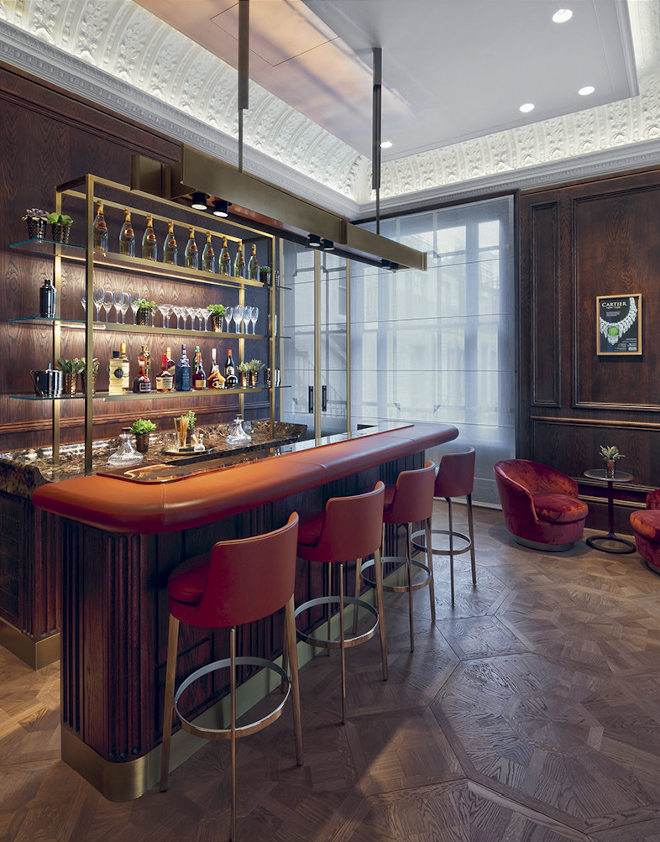
Imagine landing in London for a special event– a night at the opera, perhaps, or the Baftas – and heading straight to Cartier London’s by-appointment private apartment, The Résidence at Cartier’s Bond Street London flagship is the perfect place to prepare and select jewels for the night ahead in whole new level of literal and metaphorical luxury – an intimate yet expansive haven (about 1,600 square feet) located on the building’s second floor featuring a dining room area, a small bar staffed by expert mixologists, a boudoir-themed fitting room, a fully equipped marble bathroom and a working kitchen with a marble counter at which to dine. Word has it that there are already more than 100 events are scheduled for 2019.

Fairline To Premiere Targa 45 GT Express Cruiser at Boot Dusseldorf

Fairline will take centre stage on the opening day of Boot Dusseldorf when the British builder unveils the Targa 45 GT by Alberto Mancini.
Dec 20, 2019 | By Yacht Style
Fairline will stage the global debut of its Targa 45 GT at Boot Dusseldorf (January 18-26, 2020) as the express cruiser becomes the fourth model in the current Targa GT line-up and the ninth GT since the British builder introduced the line 15 years ago.
Fairline will show the Targa 45 GT at Boot Dusseldorf from January 18-26

Fairline’s Targa 45 GT will debut at Boot Dusseldorf, the world’s biggest indoor boat show
The new 45-footer is designed by Alberto Mancini and offers 
the same light, bright and luxurious feel of the Italian’s other new-generation designs for Fairline. The yacht features a spacious saloon, powered hardtop roof and large patio doors, which benefit both northern and southern hemisphere boating.
Wayne Huntley, Head of Design and Engineering at Fairline Yachts, said: “We are pleased to announce the upcoming addition of the Targa 45 GT to our product range, building on an already strong portfolio of yachts.
The Targa 45 GT is another Fairline design by Italian Alberto Mancini

The Targa 45 GT is another Fairline design by Italian Alberto Mancini
“We are confident that the accessible size, stunning interior and exterior design, and highly adaptable layout will appeal in every global yachting territory.”
Layout options include the choice of two or three cabins, and either a midships or forward master cabin. The tender garage can carry a Williams Minijet 280, while the standard engine options are twin Volvo IPS600 D6-440s, with the option to upgrade to Volvo’s new IPS650 D6-480 units.
The original article appears in Yacht Style Issue 50. Email subscribe@lux-inc.com for print subscription enquiries or subscribe to the Magzter version at: www.magzter.com/SG/Lux-Inc-Media/Yacht-Style/Fashion/
Design a site like this with WordPress.com
Get started